The Final Exam

Exams are an annual/semi-annual ritual most students have to experience at some point during school or university. I myself had to write one last week. While I came out mostly unscathed, this particular occasion was all the more memorable given that it was truly the final curtain for my academic career as far as written exams are concerned; this final exam, was in fact, the FINAL exam of my academic life.

While my 20-year-old counterpart would have relished and wildly celebrated such a reality, I came out of the exam hall feeling quite pensive about the whole affair. It felt like the end of a long and occasionally tortuous journey that had molded my personal perspectives and opinions about written exams, and the present-day state of education.

Back in high-school, I had considered written exams as a means to test my skills and challenge my wits. By the time I had finished undergraduate studies, my viewpoint changed drastically, with written exams no longer being my cup of tea. I attributed this to the rapid environment that is university studies where exams just became another thing on that long checklist of things to do. Accompanied by tight and narrow margins of assignments and course project deadlines, written exams and studying evolved into a race against time, a means to a letter, than an actual endeavor for knowledge. I would finish my undergraduate studies quite frustrated with how things had turned about.

Ironically enough, those very frustrations set the ground for positive aspirations in the future. A few years after my BSc. degree, I would obtain an MSc. degree, following which I would begin my doctoral studies. Written exams still remained a part of my academic life but something changed. It took me a while to figure it out, but in the end, it was quite simple. I came to the realization that written exams are full of shit.

It became quite evident that my exam writing skills didn’t correlate nor were they directly transferable to improving and supplementing my academic experience or my aptitude for research. In my case, I stumbled upon this solution in the most straightforward manner possible: working as a research assistant for one year and proving to myself that I was actually “worthy” of my academic aspirations. Yet, there should have been no reason for me to be pressured into proving this to myself.

While written exams are popularly utilized as a means to weed out the student population in a hierarchical system of academic merit, it is not by any means the most efficient. On the other hand, it has served its purpose as the great illusion that often daunts a student’s psyche with regards to being an indirect and ineffective statement on their potential, and future success.

Multiple cases in point were my encounters with various students and peers who would find average turnovers in exams, and yet remain gifted personalities with great intellects and potential. It wasn’t rare to see the same batch of students also diverge from their original academic aspirations thanks to the lack of representation that written exams (and consequently, their grades) provided for their resume.

The sheer stress and pressure of exams translated to my transcript which to this date remains a beautiful collage of letters traversing the ABCDF scheme of the grading alphabet. Those same factors also translated to an inferiority complex of sorts, culminating in the completion of my undergraduate degree, when I felt that I was not good enough for my field of choice, and that I didn’t have the potential to seek and find success at greater heights.

It took me several years to overcome this complex. It helped to recognize written exams were not the absolute judgment of one’s potential as the education system so often makes it seem. I had to admit to myself that neither my skills or potential were absolutely defined by a piece of paper that I had to complete in a closed-room environment under set rules.  This pushed me to work harder, not at writing exams or getting perfect grades, but at learning to enjoy my own pursuit of knowledge including its ups and downs.

Leaving the exam hall last week, I was glad that I had finished writing my final “final.” I could now look forward to fully and freely engaging my curiosity for knowledge, in whatever form that may be. I’m thankful to have come so far. My success in overcoming my failures in such a systematic hierarchy could largely be attributed to supportive supervisors, professors, friends, and most of all, my loving family. The trials and tribulations I faced in what had once seemed a downhill adventure in self-confidence and motivation did enact a toll upon my university studies, and yet, those very same experiences had served to strengthen me.

At the end of the day, my story may not be another’s. As such, I find it necessary in the current educational climate to find an alternative to written exams (at least in the context of university studies) in an effort to better represent and evaluate a student’s skills and knowledge. In my humble opinion, I would prefer to take the classical approach of the platonic academy where the emphasis towards knowledge and one’s academic mettle were proven through oral arguments and jousts that served to strengthen one’s ability to communicate and defend his opinions, as well as learn from that of others in what could be a collectively reinforcing experience.

I have had the opportunity to be involved in few such courses during my time at university, and have also found them to be the most rewarding. How to mold such an idea into a central gear in the current education system is a whole other problem in itself, and not one that I intend to discuss at this stage (though I do intend to come back to it soon enough).

Having said this, for now, I’m going to sit back, drink a cup of tea, enjoy the view (free of exams and assignments, but mostly a busy week catching up on research), and,

giphy.gif
RELAX!

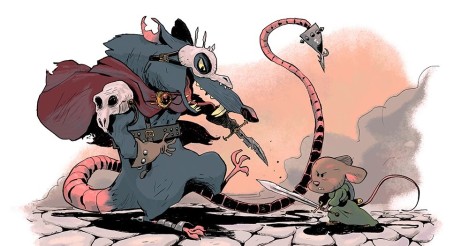
Book Review – Redwall – A Journey In Childhood Nostalgia

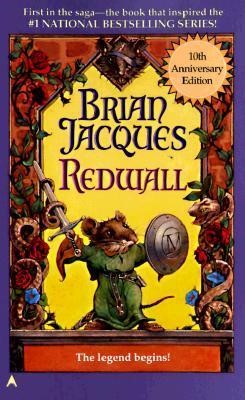
“It was the summer of the late rose.” The year was 2002, and I was a scrawny 11-year-old kid, sitting in a corner at the school library, fully immersed in Brian Jacques’ Redwall. A year had passed since my family and I first arrived in Cairo, Egypt. I was admitted at the Cairo American College (CAC) International school to complete my elementary and middle school education. The lack of a strong foundation in spoken and written English led to my registration in the English as a Second Language (ESL) program. The school library, with its treasure trove of books and resources (I hadn’t actually ever visited a library in my life till then), would naturally become a second home in my efforts to improve my hold over the English language.

redwall1

My finding of Redwall was preceded by my discovery of another great literary work in J.R.R. Tolkien’s Lord of the Rings. I was largely drawn to the illustrations on the book cover, alongside the descriptive maps in the appendix. Jousting my way through the first few pages of The Fellowship of the Ring I would ultimately give up, confused and frustrated in my inability to understand the contents.  A friendly librarian would see to it that my efforts weren’t wasted, suggesting an easier (and more suitable) read of the fantasy genre in Brian Jacques’ Redwall. Thus began my adventures with the peaceful creatures of Redwall Abbey, a journey that continues to this day.

Redwall follows the tale of a young mouse named Matthias who dreams of adventures as opposed to the quiet and peaceful life of servitude he is advised to follow by his mentors and the inhabitants of Redwall Abbey. When the abbey’s tranquil atmosphere is destroyed by the coming of Cluny the Scourge, an evil-one eyed rat warlord, Matthias must find the courage necessary in himself to step forward, become the champion of the abbey, and protect his family and loved ones.

redwall2

The primary theme of Redwall is centered on the triumph of good over evil. Jacques does not shy away from describing the harsh realities of battle, and death through the medieval setting upon which the peaceful mice, badgers, voles, hares, squirrels, sparrows, and moles fight and defeat the violent rats, weasels, snakes, stoats, and ferrets.Jacques follows the traditional template of the monomyth or the hero’s journey in his protagonist, Matthias. Matthias’ story begins at Redwall Abbey but the impending danger upon Cluny’s arrival sends him on a journey through the heart of Mossflower Woods, deep within the forests, where he faces and succeeds in the hero’s challenge to obtain the courage required to save the abbey and vanquish its enemies.

redwall3
“Imagination is a gift given to us from God and each one of us use it differently.”

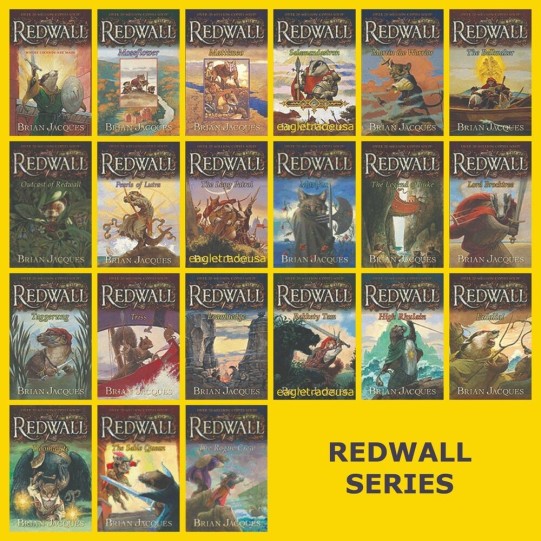
Jacques’ vivid descriptions of his characters, as well as his unique style in combining action, poetry, and songs makes for a wonderful read for both children and adults alike. It comes of no surprise then that Jacques’ Redwall  was originally dedicated to his friends, the children of the Royal Wavertree School for the Blind, whom he first met while working as a milkman. The success of Redwall kick-started the growth of a 22-book series that now has a lasting legacy as among the best of children’s fantasy novels.

Reading Redwall in 2002, I was captivated by the world Jacques’ had constructed in his novel. Now, almost 17 years down the road and having recently re-read the novel, I cannot deny the childhood nostalgia that sums my experience of Redwall and the influence it has had in my own efforts to writing books in the fantasy genre for a diverse audience. The enduring cast of Redwall characters, their trials and tribulations, and their ultimate success provide, in my humble opinion, valuable lessons in courage, love, peace, family, and freedom. While the overall series may be guilty, on certain occasions, of recycling old plot lines and propagating an obvious pattern of predictability, Jacques’ Redwall sets the stage for an unforgettable journey alongside memorable and diverse characters in a story that is full of heart.

redwall4

Oops…

So, here’s a quick update to all my readers. After publishing my last post, I was parsing through my blog, when I noticed that while I had decided to write about meteor showers on my next post, I had done exactly that a few months back on August 21, 2017.

caa365306252b6299ce4c1269c48d774
Baaakaaa….

I can attribute my forgetfulness to the recent bout of work and lack of sleep that has been following me over the last few days along with the happiness of dealing with the persistent paparazzi of my studies.

bf27147f5658d7d8decea273f7b1e756ff174ed5_hq
My new look over the last week or so…thanks to a lack of sleep and an intense regiment of writing a paper on my research. 

Having said this, I’ve decided to scrap my prior idea and instead will publish a post later this week on the wonderful adventure that has been my life in university so far. Eight years and still running (hopefully the cycle will end in three more years when I intend to complete my degree), I’ve realized there is a lot I can share ranging a large spectrum of experiences!

My goal is to provide a window into the life of an academic, strictly from the humble viewpoint of a student. I hope to also share my own opinions and expound on the lessons I have learned along the way. For those among my readers who may also be contemplating on their chances in academia, I hope the post will provide much needed insight!

That’s all for now! See you all very soon!

Exams, Assignments, and All-Nighters

Last week was a throwback to my past as an undergraduate student when I pulled off my third all-nighter over the last eight years of studies at university. Now, an exam looms upon the horizon, followed by scores of assignments and research objectives to manage…Indeed, the gauntlet has been thrown, and I have made my decision…

FiZulWv

While I may not necessarily have an official fellowship to assist me, I take heart in that I have my fellow classmates and friends who shall also suffer in this war with me.

Bound to this confounding cycle of…

meme10 (1)

I find solace in my pensive reverie…So, having said that, hi everyone!

It has been a busy few days, but I’m hoping to regain my bearings once I complete my midterm exam this week. Looking ahead, I will be posting on my experiences so far in independent publishing having recently published my second book: A Little Bit Of Everything. 

September was also a month of several delightful surprises, not to mention, my first viewing of the Northern Lights (which occurred during a casual walk home one night from the superstore). As awesome as it was to observe the celestial event, which was surprisingly clear despite the light pollution in the city that night, I plan to write a small anecdote on the phenomenon itself touching base with my general passion for astronomy.

I now leave you all with this short update as I once again embark on the Sisyphean expedition that my PhD research has become, not to mention the general course of assignments and course work to follow. It is certainly the calm before the storm as I prepare for my midterm but with a creeping doubt where I’m,

ca9d516abe85cd58a45ecc56b0c099e6--final-exam-memes-exams-memes

As the bells of exam halls toll,

exam4
Correction: Mid-semester, the war will truly come to an end at the end of the semester.

I shall fight the good fight, and do my best so that I may soon reengage all of you, my fellow readers and friends, at The Pensive Reverie with some delightful tales, amid auroras and published books, of what has been a beautiful fall season.

On the Nature of Knowledge

Introduction

So, after a week of thoughtful contemplation amid myriad deadlines, I’m excited to finally post my discussion “On the Nature of Knowledge.” I contested two methods of approach in presenting this topic: one that is grounded in philosophy, and the other that is inspired from my personal experience as a student. Ultimately, I’ve decided to stick with the latter as it would be consistent with how I’ve addressed most of the topics posted on this blog. For anyone wishing to tackle the same topic from a philosophical perspective, check out epistemology (the Stanford Encyclopedia of Philosophy provides an awesome introduction on the subject).

Our discussion will be divided into three separate parts dealing with the following questions:

(1) What is knowledge?
(2) What is knowledge from a student’s perspective?
(3) What is the purpose of knowledge?

tumblr_n2uamjciss1ssbae2o1_500
Seems simple enough!

My objective today will be to share my personal experience and growth over the last seven years of my undergraduate and graduate studies, during which I actively and repeatedly engaged these questions. I’m well aware of the various generalizations that can be made in answering these questions, but my opinions will converge and revolve around the viewpoints I’ve accepted in my personal journey to discover those same answers as a student. Let’s begin!

What is knowledge?

I believe knowledge can be defined via three categories: personal, factual, and action-based knowledge.

Personal knowledge revolves about the knowledge gained by acquaintance with the objects, the events, and the people in one’s environment. Having just arrived in Canada for my undergraduate studies, the foundation of my life was built around the expectations and experiences I had with my family living in India, Egypt, and Sudan. Commencing my studies at the University of Alberta while living in student residence, working part-time and volunteering in various activities, my personal growth as an individual continued as I mingled and became familiar with an alien environment. My new-found freedom allowed me to fully experience and question my individuality, a process that would culminate in my identity crisis several years down the road (one that I have thankfully resolved). Knowledge, in this sense, is acquainted with my familiarity toward objects in my environment as well as the delegation of my recognition to said objects, and was highly influential in defining my identity and my decisions. Altogether, personal knowledge is very much a book in progress in our individual lives. Its measures and ends are dictated by our environments, personal motivations, and growth while actively influencing all three of those aspects.

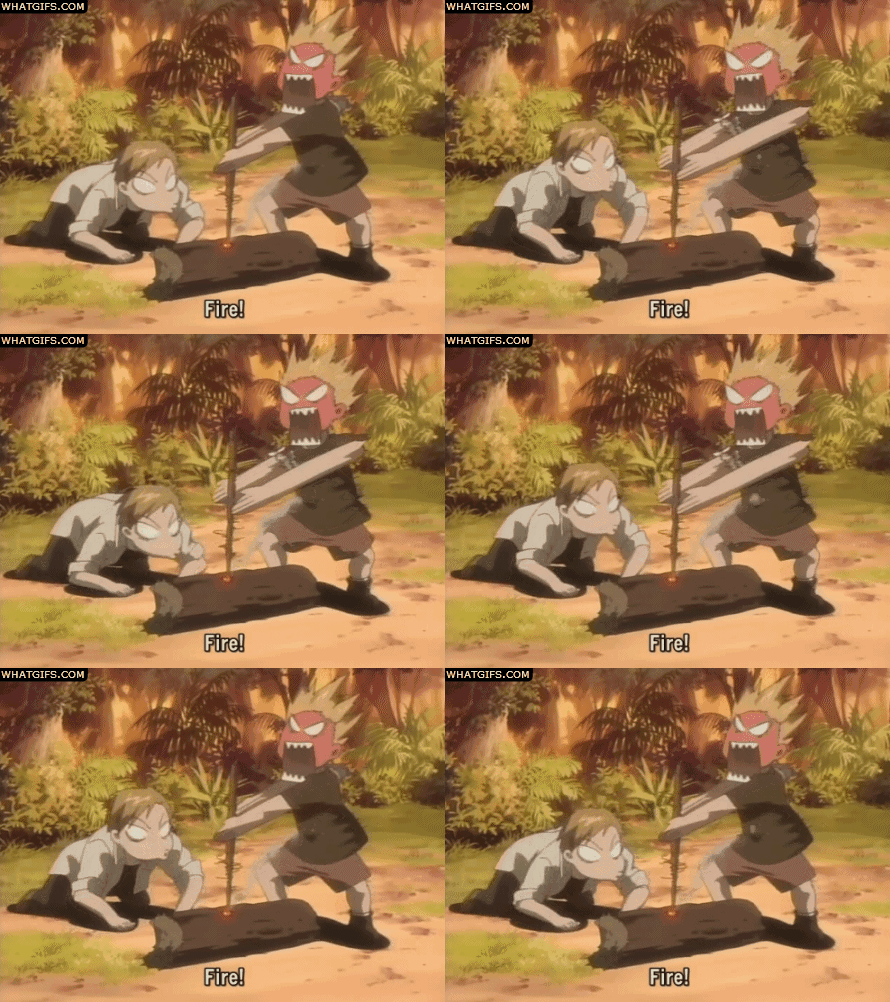
Action-based knowledge is the knowledge of how to do something. This would involve one’s abilities to do something, like driving a car or starting a campfire.

tumblr_n0t67kvwnq1s1a2b1o1_500

On the other hand, factual knowledge, as is obvious, is the knowledge of facts. Action-based knowledge is different from factual knowledge. One may know the theory behind driving a car, while not actually knowing how to drive a car. Factual knowledge is evident in both action-based, and personal knowledge. With personal knowledge, in order to speak with others, one must  know how to communicate. One doesn’t necessarily know a person just by meeting them, one must also know a few things about them. Similarly, with action-based knowledge, one must know certain facts about driving, like the motion of the car with respect to actions on the steering wheel, to assist and help them actually drive the car.

Despite this, factual knowledge is alone not enough. Personal knowledge involves the need for action-based knowledge that helps an individual acquire the necessary skills to interact with his/her environment, and action-based knowledge may require some factual knowledge, but that same factual knowledge cannot amount towards action-based knowledge. In fact, one could say that there is no definitive standard of connection between these three categories of knowledge, seeing how much they intermesh. For the philosophy lovers, epistemology deals largely with the views of factual knowledge.

What is knowledge from a student’s perspective? 

How does this all come together for a student? Well, one of the main reasons we go to school is to cultivate our knowledge and understanding of the world. At university, this may largely be oriented by our aspirations on a field that would preferably model our future careers. I say “may” as I believe the purpose of higher studies does not have to primarily revolve about one’s career or prospective choice of employment (this in itself, leads to the crucial discussion on the structures of education or educational systems).

tumblr_nxl4ow3qdc1ux2dlwo1_500
Have…To…Keep…Going….

As a student, much of our time at university involves absorbing the factual knowledge before actually implementing them in the real world. Our action-based knowledge is attested to our success with such implementations. It is pretty similar to the notion of the scientific method, where theory precedes experiment in a repetitive cycle. This is where we also learn the difference between the static process of remembering knowledge versus the dynamic process of applying said knowledge. This is at the core of our ability to learn and interact with our environment, and is a social behavior whose roots are sown in our evolution as a species.

Factoring on to this is the personal knowledge that every individual inhibits. Being a student, you’re part of a community, one that we may or may not socialize with (each with its own share of circumstances). Putting aside the knowledge we gain from our courses, the personal knowledge we exhibit provides for the competitive play of our social lives from networking, to the establishment of our status, while satiating our thirst and drive for recognition.

All of which now leads us to ask, what is the purpose of knowledge in general?

What is the purpose of knowledge? 

Personally, to this day, I believe an individual’s knowledge is characterized not only by their ideas, but also how they act upon them. The question on the purpose of knowledge derives greatly from the means of education an individual may seek, which by itself, is an even bigger discussion.

I’ve come to recognize how influential the methods utilized to propagate knowledge at an academic institution can be on its community (teachers and students alike). After my four years of undergraduate studies, I was spent, and in many ways had to rediscover my personal creativity and motivation. Following a gap year, I pursued graduate studies, which I just recently completed. Looking back at my experience, I must say that a large part of my journey also had its run of the mill circumstances surrounding my identity crisis, but I cannot deny that it came with its share of new and enlightening perspectives involving my personal opinions on the educational systems of modern-day academic institutions.

What is the purpose of knowledge? I believe it is what it is, for every one of us, however we wish to see it.

e866ca4712e838e3798f2cdc4861f84d

 If there is one attribute to my personality that I have always been proud of, it would be my undying curiosity, and endless thirst for knowledge. In my life, this has changed from a wish to understand the world, to sharing said knowledge, and to contributing my own by enhancing the source of said knowledge. The Pensive Reverie is in fact a personification of my desire to share my knowledge, as an individual, to the world. Ultimately, as Francis Bacon put it, “Knowledge is power” but I also believe what we do with said power defines the object for each and every individual.

Next up: On the Nature of Knowledge

Hi everyone,

Just wanted to send out a brief update on the topic I have decided to discuss for my next post. It took a few days of deliberation and careful thought, and given my recent completion of graduate studies, I felt it would be ideal to discuss On the nature of knowledge. 

I’m well aware of the various intricacies and the large volume of literature dedicated to this subject (it is in fact a field called epistemology.) As usual, my treatment of the topic will revolve around my personal experiences albeit with some casual references to quotations and critical analyses provided by professional savants.

I wish to focus, in particular, on the role of knowledge, and how it is integrated and implemented in current educational trends at schools and universities. As an aspiring PhD student, and as an autodidact, my views on education vary from the classroom to my personal work-space at home. I have often questioned the purpose of the knowledge that I have accumulated throughout my life, both in social and academic contexts, and how to appropriately and selectively apply said knowledge in my daily adventures as a foundation towards a healthy lifestyle. Such a thought has also widely influenced my methods of finding means to an end when it comes to my dreams to be a multi-talented and well-rounded individual.

Having successfully completed another major phase of education in my Masters degree, I felt it would be entertaining to discuss a question that has been quite significant in my daily life, and is pretty much a common occurrence in almost everyone’s daily lives and careers.

I should have the post up by the end of this weekend. Until then, toodles!