Hi everyone, I’m back from my brief hiatus. I wanted to do something different this time, and am looking for an interesting topic to discuss, and post on the blog. I’m open to ideas, so feel free to name your choice of interest by commenting on the post.
For as long as I can remember, I have contemplated the measure of these questions, and yet it is in their stubborn company, that I’ve discovered the foundations of my future ambitions, and dreams. It is a journey that I’ve recounted with great enthusiasm, and vigor in Our Last Summer, and of recent, in Agent X.
Thinking back over the 25 years that have comprised my existence, I’m grateful for all that life has offered me. It is an experience that I liken to a blissful dream or even a pensive reverie (no pun intended), and one that is yet to end. To cherish the memories of the past, to live the present to the fullest, and happily anticipate the future; this is my motto, a personal philosophy that I’ve maintained throughout the countless adventures, and memorable experiences that have made me the man I am today.
And yet, despite all my progress, life still manages to surprise me at every end.
On Love
What captivates me the most is the peculiar nature with which we carry ourselves; each of us dictated, and bound by what we accept to be true. But, truth is merely a vague concept. At times, it is a fact that is provided to us by the institutions that we are born into, or the ideologies that we digest from the surrounding environment. Ultimately, the reality that we find in its promises may all be a mirage, a world that is conceived by nothing more than our individual beliefs, and thus leading us to wrongly judge others based on our own preconceptions, and by their appearances.
It is a struggle that resonates in the very fabric of human communication, and yet it is in its assured reality that we also discover our greatest freedom. A freedom that is constituted by our ability to accept the same, and move forward with goodwill, and faith; a freedom that prompts us to accept our inhibitions, and misgivings, allowing us to find unity amid the differences that set us apart in an emotion that we call love.
It takes great courage to fall in love, for by falling in love we also admit to our greatest fears, and learn to rise above them (at least, that’s how it turned out in my life). I found the answers to my questions in love. As such, I’m thankful for the support I have received from my family; I’m grateful for the acceptance I’ve found among my friends; and I’m happy beyond words in the fulfillment of the bond I share with my partner.
Life, as it is…
Much of what I’ve learned has revolved around the complex, and diverse rituals of relationships that constitute the flow of daily life; a fundamental theme that forms the basis of my work in Our Last Summer, and Agent X. Now, as I venture upon the horizon of a new chapter, I can’t help but sift through the pages of my past in what has been a humbling experience from my childhood, to my teenage years, all the way to where I’m now contemplating, drifting amid the warm winds of a summer night, the wonders of life, as it is…
“A man is but a product of his thoughts; what he thinks, he becomes.” – Mahatma Gandhi
Hi everyone, so here we are, already a month into 2017!
I’m now one week into my two-month vacation in Bangalore, India. Arriving on the wee hours of January 17th, my break got off to a rough start as I was sick for a week, not to mention the jet lag, and the time difference. Thankfully, I made a full recovery last weekend, and have been enjoying my time with my family.
Bangalore ain’t necessarily my hometown, which is actually further south at Madurai.
Prior to my departure, I had worked my ass off content editing Agent X, a two-week challenge that left me fatigued, and deserving a brief hiatus from the computer screen. While falling sick didn’t necessarily make for a great experience, I can confidently say it did the job of keeping me away from my laptop for long enough that I’m now refreshed, and ready to continue.
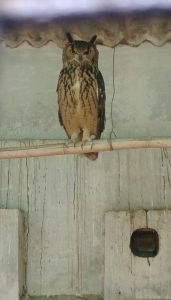
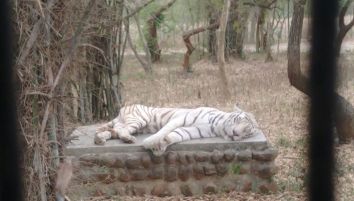
Apart from the rudimentary rituals of daily life at home, I also had the chance to embark on a wild-life safari with my family where I visited my fellow animal friends in tigers, lions, zebras, bears, and many others from the crocodylidae, and aves families at the Bannerghata National Park.
What are you looking at? Too tired to give a damn.
But, amidst all the entertainment, I discovered occasional pockets of silence that helped me contemplate on the roller-coaster of a ride 2016 has been, both personally, and on the grander scale of events that have “rocked” the world.
While completing my second book has followed on the success of my Masters degree, I still found room for improvement in my life, and my ambitions for the future; a future that seems to be rapidly changing in concert with the events that have occurred in 2016. Though many such events did not affect me directly, I felt compelled to wage a healthy debate on said occurrences, and their direct implication for the future of the current generation of youngsters.
I’m referring to the recent establishment of a new leadership, the breaking of an alliance, the carnage of war, the mass exoduses, and the various other events that have displaced the state of the world extensively over the short duration of a single year. Buried among the various differences that set these events apart, there remains one lasting impression: the monotonous manner with which the various bureaucracies of the world, have monitored, and administered the lives of its citizens, and those of others; governments that have embezzled peoples’ beliefs, leading them along a misled, and deceptive path of life colored with extravagant rhetoric, but vacant promises.
Now in an age where we find limited invitations toward discussion, and recourse, there certainly are many youngsters, just like me, pondering their individual circumstances amid a changing world. A world filled with barriers, the least of which involves a great divide in communication. We either get bogged down in communication to the point where we are incapable of action, or vice-versa. But this inability of ours is also a daunting characteristic of human nature, and one which we must learn to overcome or make amends with if we are hoping
All of which brings me back to this pensive reverie, where I’d like to believe that by writing brief posts about the state of the world, my personal interests, and adventures that I may be contributing, at least a small bit, to a common desire of a generation that wishes its voice to be heard amid the swift tempest of the world. Now, I know this piece may have sounded quite out of sorts among the previous posts that I have uploaded on the blog, but it is a first step towards the greater plans I have in 2017 to branch out in the discussions I wish to provide in the blog. More specifically, it was just a play of words on the thoughts that came across my mind during my daily ruminations. Next up on the list, and certainly a tad different from the subject above, “Why is snow so bright?”
“What seest thou else in the dark backward and abysm of time?” – William Shakespeare
Time is a component quantity of our daily lives. It is symbolic of the indefinite progress of existence, and events that are generally considered to occur in an apparently irreversible sequence from the past, to the present, and onto the future.
The concept of time has been central to the growth, and evolution of human civilizations. It has also served as an important facet of knowledge that has been studied to a great effect in religion, philosophy, and science. But, to this day, an absolute definition of time still evades scholars.
In The Dragons of Eden, Sagan does not extend his arguments toward an extensive discussion on the concept of time, but rather focuses on its use as a metaphor to describe humanity’s place in the cosmos. To infer the future, it is necessary for us to understand our origins. This is the basis of Sagan’s approach.
Now, it is argued that the predecessors of modern-day human beings, the Homo sapiens¸ evolved somewhere between 250,000, and 400,000 years ago. This number pales in comparison to the appearance of the first primitive humans, such as the Australopithecines, which happened somewhere between 8-9 million years ago. But, even these events, are preceded by an even greater “vista of time” reaching far back into the history of our planet, the solar system, and the universe. Very little is known about these periods of time, and even with the numbers mentioned earlier, we still struggle to grasp the immensity of these time intervals (Figure 1).
Figure 1. Humanity is yet to define its existence amidst the vast cosmos.
Nevertheless, science has found success in the establishment of specific methods that have allowed us to date events from the remote past, such as geological stratification (Figure 2), and radioactive dating (Figure 3).
Figure 2. Geological stratification, bluntly said, involves the study of rock layers, and layering.Figure 3. Radioactive dating is a technique involving the tracing of radioactive materials in select objects, carbon dating is one such method that is limited to the dating of organic (carbon-based) organisms.
These two methods have provided information on archaeological, paleontological, and geological events. Astrophysical theory has provided for the same on a grander scale involving the dating of stars, planetary surfaces, galaxies, and the even the age of the universe (Sagan states this to be 15 billion years old, though recent results from the Wilkinson Microwave Anisotropy Probe (WMAP) puts the number somewhere at 14 billion years old). The earliest event known in record is called the Big Bang, an intense explosion from the universe is said to have formed, but rather than a beginning, the Big Bang is generally considered to be a discontinuity in time where the earlier history of the universe was destroyed.
To put this further into perspective, Sagan introduces the Cosmic Calendar, where he compresses the 14-billion-year-old chronology of the universe, into the span of a single earth year. In this manner, one billion years of Earth history is the equivalent of twenty-four days of our cosmic year, and one second of the cosmic year is the same as 475 real revolutions of the Earth about the sun. The Cosmic Calendar is a humbling account of humanity’s place in the universe, with all our recorded history occupying the last few seconds of December 31.
Though a short chapter, Sagan’s use of the Cosmic Calendar is quite analogous to a common argument used in astronomy to provide a picture of our place in the universe (Figure 4).
Figure 4. Our place in the universe. The planet Earth is smaller than a speck among the greater part of the observable universe.
While the major premise of Sagan’s book focuses on discussions on the evolution of human intelligence, this introductory chapter is a necessary prelude that helps to symbolize the significance of the subject matter. While it may be true that humanity occupies an insignificant instance in the face of cosmic time, we are now embarking on a new cosmic year, one which is highly dependent on our ability as a species to come together, use our wisdom, and unique sensitivity to the world for our survival, and a greater future.
References
Sagan, Carl. The Dragons of Eden: Speculations On The Evolution of Human Intelligence. Ballantine Books, 1977.
Just wanted to provide a general update, before putting up my review on Chapter 1 of Carl Sagan’s The Dragons of Eden.
I know it has been a long wait, and I apologize for the delay, but I’ve experienced quite a productive, and intense week. I was finally able to complete the content editing required on Agent X, and now have a first draft of the book. I hope to pursue further editing in the future before proceeding towards any plans to publication.
I had hoped for a wonderful beginning to 2017, and on the heels of this personal achievement, I can say my confidence is at an all-time high. Having just also traveled back to visit my family in India, I’m currently recovering from jet lag. Nevertheless, the wait is now over, and it is now time for me to get the ball rolling on my plans for the blog, but before that, I’d like to thank you all for your patience!!
Hi everyone, I’m back! Sorry for the delay in uploading the post. I’ve been busy with the merry season currently in full swing. I had promised that I would provide an update of my two week season of sickness, and I will stay true to that promise with this post, which will basically cover what has happened in my life so far, and what I’m really looking forward to with 2017 just around the corner. Now, I may be four days late for one, and two days early for another, but I would first like to wish all my readers,
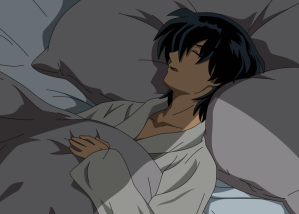
Let’s begin! December 9 was the beginning to a memorable end of the roller-coaster ride that has been 2016, and it started with me falling sick. What started out as a mild cold became a sore throat followed by a week of quality time with my good old friend, the bed. While physically bedridden, mentally, I was primed. Aside from pondering the purpose of my existence as I lay in bed, my mind was overwhelmed with an insurmountable wave of creativity helping me set up the groundwork for 2017 regarding my plans for forthcoming writing projects, my career (as I will begin my PhD studies in September 2017), my work as a budding manga writer, building on the developments for The Pensive Reverie etc.
So many ideas! Why did I have to fall sick in the first place for this to happen?!
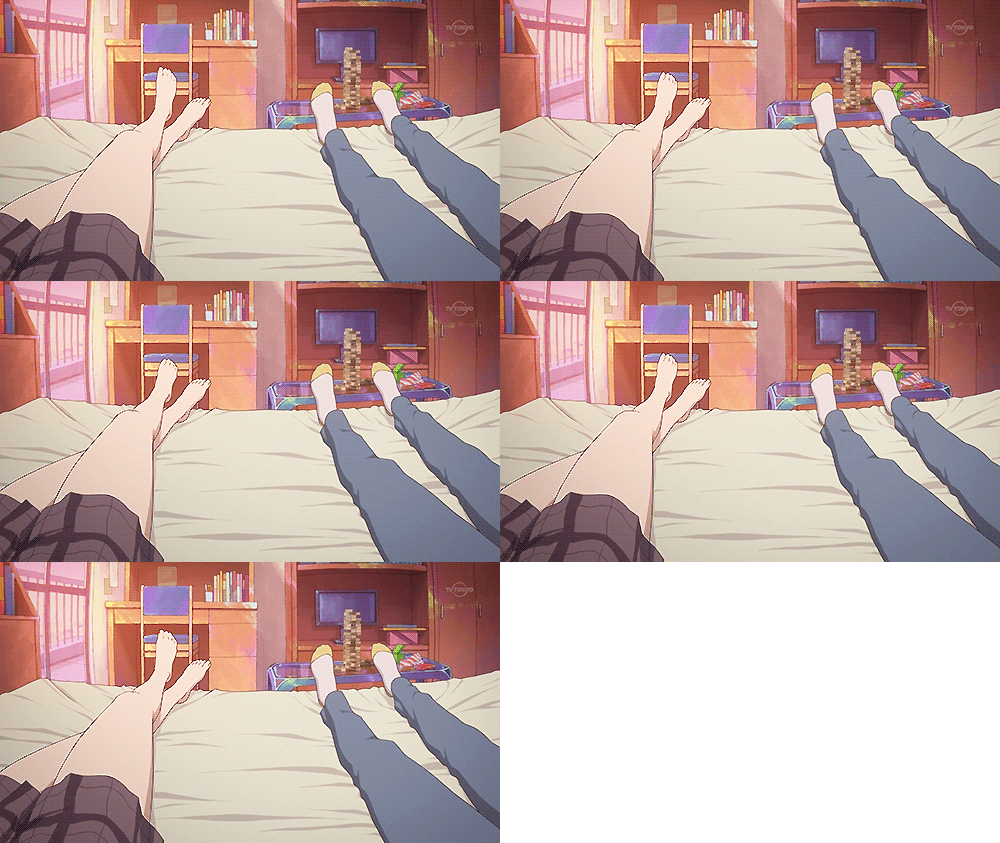
Thankfully, I was not alone in this wonderful exodus as I was accompanied all the way by my ever gracious partner who also fell sick. This meant some quality time together doodling about, playing board games, binge-watching TV shows, further discussions, now, on the purpose of our collective existence, and pretty much waiting for time to pass just so that we can feel better again.
Jenga (check), TV (check), fast-food (check), tissue-box (check), Are we both sick? (check).
But in the end, we were both able to make a complete recovery right on time for Christmas allowing us to round up this past weekend by celebrating the merry season as well as our four year anniversary together as a couple!
These four years have been a wonderful adventure, and I can’t wait for many more to come. Thanks so much for bringing so much joy, and happiness into my life.
To my partner Leina,
あなたはわたしのゆめのじょせいだ。
はじめてあたときからすきだた。
いつまでもいっしょにいたい。
愛しています。
Now, with 2016 coming to a close, I have successfully completed my robotics internship, and am currently going through a rigorous course of content editing Agent X [my second book!] I hope to get this done by January 15, 2017, and moving forward from there, set in motion my plans for publishing the book, as well as promoting my work on this blog! At about the same time, I will be traveling to India to visit my family on a much needed vacation.
Can’t wait to see you all very soon!
It’s been eight years since I last visited my hometown so I’m looking forward to returning home. In the meanwhile, I intend to keep up with my weekly blog posts, and discuss my daily adventures. I will keep you all posted in case of impending delays or absences.
And, that basically all there is to it! I wanted to keep this blog post short, and simple. I will soon be posting my analysis on Chapter 1 of Dragons of Eden where we will discuss the cosmic calendar, and have a brief adventure involving interesting theories, and discoveries in the field of cosmology!
I apologize for my brief absence. I fell sick with a severe cold coming into the first week of December, which pretty much brought my progress on a bunch of things to a stand-still. I’ve just made my recovery, and am now back on track to get the ball moving.
Being sick is not fun!
I will begin by writing the next post on my read along of The Dragons of Eden, which will be up by the end of this week. I will also provide a comical summary of what I had been up to while I was sick. Though I was physically out of it, I was mentally surging with ideas, and with the approach of 2017 around the corner, there is a lot I have planned for, and which I will provide a brief summary of as well!
Mankind is poised midway between the gods and the beasts. – Plotinus
Plotinus’ quote is symbolic of a fundamental biological principle illustrating that man is descended from some lowly organized form, and which serves as the backdrop to the discussions Carl Sagan (Figure 1) presents in The Dragons of Eden. In order to provide a description of nature, and human growth, Sagan begins by discussing this principle, one that distinctly identifies the field from other physical sciences, evolution by natural selection.
Figure 1. Carl Sagan, noted astronomer, science communicator, and author of The Dragons of Eden.
Let’s digest that last bit, piece by piece. The word evolution is commonly used to describe the gradual development of something, from a simple to a more complex form. In scientific terms, evolution is the change evidenced in hereditary characteristics that are carried over successive generations in biological populations. It is the fundamental process that has led to biodiversity within species, and individual organisms.
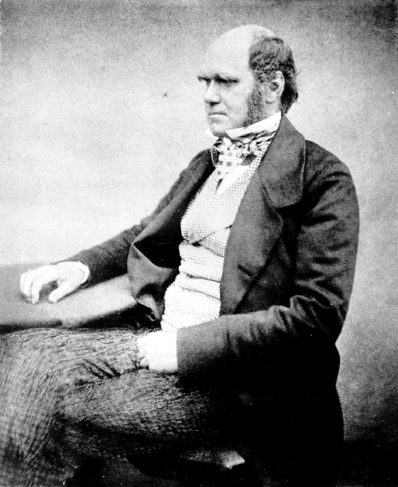
Figure 2. Charles Darwin
Natural selection was the brilliant discovery of Charles Darwin and Alfred Russell Wallace (Figures2-3), detailed in the publication of their joint works in 1858. It is the theory that describes evolution, and is the preferential survival and reproduction of organisms that are by accident better adapted to the environment.
Figure 3. Alfred Russell Wallace
Natural selection is due to differences in the phenotypes of individual organisms. A phenotype is basically a composite description of an organism’s traits and characteristics including its physical and biochemical properties, as well as morphology, development, and behavior. An organism’s phenotype is a consequence of an organism’s genetic code, or genotype, along with environmental factors, and the collective influence and interaction of the two. It is important to differentiate natural selection from artificial selection, or selective breeding, where humans use animal and plant breeding to “select” for the development of particular characteristics by choosing which males and females of animal and plant species will sexually reproduce, and have offspring together.
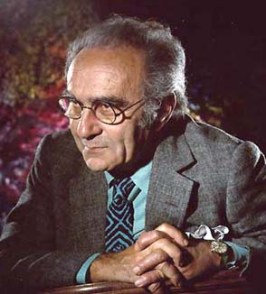
In The Dragons of Eden, Sagan, much like Jacob Bronowski (Figure4), best remembered as the presenter and writer of the 1973 BBC television documentary series, The Ascent of Man, wants to provide an account of how human beings and human brains “evolved” or grew up together. By understanding the evolution of human beings and human brains, Sagan intends to provide a platform from which he can speculate on the nature of human intelligence, its evolution, and its future.
Figure 4. Jacob Bronowski was a British mathematician, historian of science, theatre author, poet and inventor.
For starters, he addresses the role of knowledge and learning in a species’ ability to survive, and adapt to its environment. In order for an organism to survive, it must have the basic ability to extract and manipulate information from the environment. Most organisms depend on their genetic information to survive, but in their lifetime, they can also collect extragenetic information. On the other hand, humans and mammals exclusively depend on extragenetic information.
Mammals are warm-blooded (maintaining a constant body temperature compared to the temperature of the environment), vertebrate (have a backbone or spinal column) animals distinguished from other animal classes by their possession of hair or fur, the birth of live young, and the secretion of milk by the females for the nourishment of the young.
While our genetic history does exert a significant influence in our behavior, our brains allow for us to interact at a higher level with what we learn from the environment. This has drastically enhanced the chances of survival of the human species. Human beings have also invented extrasomatic knowledge, or information that can be stored outside our bodies, writing being a notable example. As Sagan points out, our dependence on extragenetic, and extrasomatic information is crucial to the survival of our species. Since the timescales involving evolutionary or genetic change is far too long, we cannot depend on a process that may take place over hundred thousands to millions of years in order to keep up with the changes that we encounter in the world. In fact, we now live in a time where our world is changing at an unprecedented rate. To deal with an unknown and perilous future, Sagan insists it will be necessary for humans to actively consider the changes in our environment, and learn to adapt, control, and adjust our lifestyles accordingly. Our survival relies on the evolution, growth, and sensitivity of human intelligence, which has been a solution and a cause to the many problems and changes that afflict our species (Figure5).
Figure 5. Our evolution is tied to the growth of our environment, and vice versa.
Sagan’s interests in addressing the evolution of human intelligence is also an extension of the work he accomplished at SETI (Search for Extraterrestrial Intelligence) as the insights we derive from an investigation of terrestrial intelligence will help in our search for extraterrestrial intelligence.
Both the existence of those other civilizations and the nature of the messages they may be sending depend on the universality of the process of evolution of intelligence that has occurred on Earth. – Carl Sagan, The Dragons of Eden
Ultimately, his treatment of the evolution of the brain will assume that its workings, or what can be called the mind, are a result of its physiology and anatomy. His primary goal in addressing the evolution of human intelligence is to dissect the various aspects of a subject that touches base with various other scientific fields. By understanding the evolution of human intelligence, he stresses the insight that can be gained from the interactions between brain physiology, anatomy, and human introspection.
Figure 6. René Descartes, addressed the mind-body problem in the 17th century. He believed that inputs from the environment were passed on by the sensory organs to the brain and from there to the immaterial spirit
With this approach, Sagan considers the “mind” to be the result of collective processes of the components of the brain, and chooses to not entertain the hypothesis of what is called the mind-body dualism (Figure 6). The mind-body problem deals with various arguments about how mental states, events, and processes can be related to physical states, and likewise, with the governing assumption that the human body is a physical entity, while the mind is non-physical. (The Stanford Enyclopedia of Philosophy is a wonderful primer’s read-through of this highly detailed topic.)
And that’s all there is to the introduction! While it may read as a book review, the introduction is a concise summary of what we will see later in the book. Now, to reiterate, Sagan’s work in The Dragons of Eden is presented against the backdrop of the theory of evolution. Since its induction in science, evolution has garnered its share of controversy, and disagreement. To all my readers, by reviewing this book, I am in no way forcing these views, and arguments on you. Science is not dogmatic, neither should it be in its endeavor to discover the nature of our world, and our place in it. It is an open stage, and thus, I leave it to you, my readers,to decide on the views you wish to accept, and decline in my review of the book.
References
Sagan, Carl. The Dragons of Eden: Speculations On The Evolution of Human Intelligence. Ballantine Books, 1977.
This update comes a little later than I had originally planned. I’ve been quite productive over the last two weeks. Having recently completed my second book, I have been content editing the story, while organizing my agenda for the upcoming year, involving everything from independent course studies in Robotics, setting up my next three writing projects, traveling back home to visit my family in India, and a lot more. Just like I had mentioned in my previous post, I’ve also followed up on the changes I proposed for the blog. You should now be able to see a menu at the top of the blog’s main page, where I’ve categorized the blog’s contents accordingly as follows:
(1) About – A short introduction to the author of the blog, me, as well as a description of the blog’s purpose.
(2) Contact – Here is where you, my readers, can contact me, by filling in the contact form.
(3) General – Blog updates, and promotions.
(4) A Slice of Life – Here is where my posts concerning my daily adventures will be archived.
(5) Book Reviews – Here is where I will post reviews of the books I have read. So far, I have done two including The Silmarillion, and Star Wars: The Old Republic: Revan.
(6) Read Along – Apart from book reviews, I will provide for summaries, and analyses on the contents of selective books I read.
(7) Let’s Get Thinking – Critical discussions with relevance to literature, science, philosophy, politics, and just about anything that can wrack my brain.
(8) Learner Space – I’m still yet to decide on how to go about this, but as of now, I feel the Learner Space will be an archive for posts where I intend to provide for detailed tutorials on various subjects. Unlike the prior category, these discussions will be a lot more involved, and will closely resemble one of my earlier posts on Electricity: Principles, and Applications!
All the blog posts will appear as usual, on the main page, but will automatically be archived among the above categories. This will provide a structure to the blog, as well as allow for easy access to specific posts you wish to read. Further changes I wish to implement in the coming days include:
-A link to my Goodreads account, which will keep you all well-informed on my current reading list.
-I’m trying to set up an autograph widget on WordPress for Our Last Summer: A Personal Memoir. I’m hoping e-book autograph sites like Authorgraph will help set this up, so that I can provide free autographs for anyone who has purchased my e-books!
-Commentary spaces on my posts which will help you all to personally interact with the blog, and its content. A comment policy will be announced in the near future.
Altogether, I hope that by 2017 the blog will be a busy haven for discussion, learning, and fun! I will keep you all posted on everything! On the other hand, I will upload a new post this week, analyzing the introductory chapters of Carl Sagan’s The Dragons of Eden (the first of the many books that will be a read along with you, my audience).
I was 12 years old when I first got my hands on The Hobbit, while absent-mindedly exploring my school library’s fantasy collection, and that was about it. In the years that followed, I watched various animated and live-action film adaptations of Tolkien’s works, but ultimately didn’t commit to fully reading The Lord of the Rings (LOTR) trilogy. In retrospect, I could attribute this to my inability then, to fully appreciate the depth and grandeur of Tolkien’s Middle-Earth.
It wasn’t until the final year of my undergraduate studies, when I met my partner Leina, who was herself an avid fan of Tolkien, that my interests in the events and rich history of Middle-Earth were renewed. I ended up re-watching Peter Jackson’s adaptation of the LOTR trilogy, and later indulged heavily on the online forums and wikis dedicated to Tolkien’s mythology, digesting pretty much all that there was to learn about Middle-Earth. But reading wikis and online forums is a completely different matter from actually reading the books.
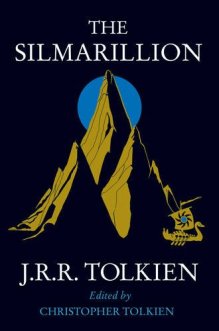
And so, I purchased The Silmarillion, eventually completing what was an adventurous ride through Eä over the course of the last three months.
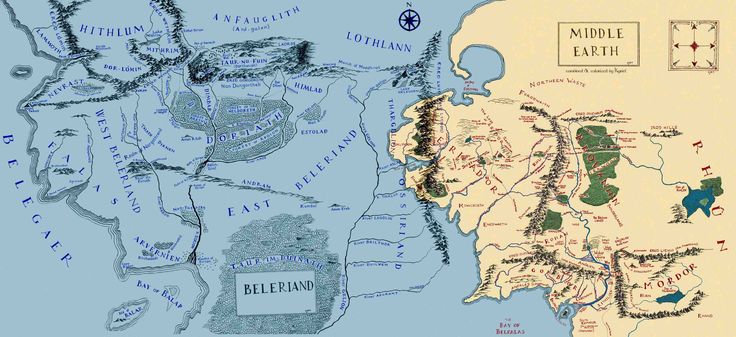
The Silmarillion is a collection of J.R.R. Tolkien’s mythopoeic works that were edited and published posthumously by his son Christopher Tolkien in 1977. Itis a narrative describing the universe of Eä where exist the mythical lands of Valinor, Beleriand, Numénor, and lastly, Middle-Earth, which serves as the backdrop for the events of The Hobbit and The Lord of the Rings.
The narrative is incomplete, ranging over prominent events and happenings in the Elder Days (the First Age in Tolkien’s world) comprising Eä’s creation to the downfall of Morgoth (the prime antagonist of the First Age), much of which would be forgotten in the coming of the Second and Third Ages detailing the rise and fall of Sauron, Morgoth’s lieutenant.
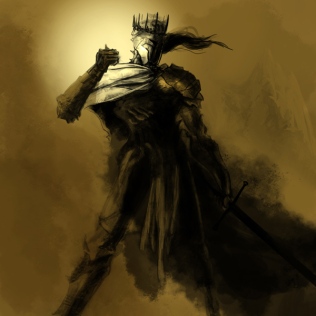
Melkor, “He who arises in might”, later known as Morgoth, the Black Enemy.
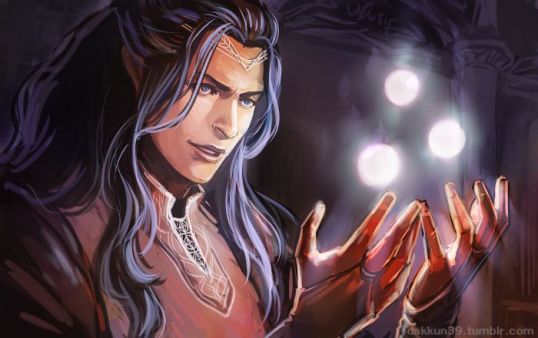
While the tales of The Hobbit and The Lord of the Rings chiefly concern the events surrounding Sauron’s One Ring of power, the foundation of The Silmarillion revolves about the Silmarils, three jewels that were created by Feänor, the most gifted among the Elves. Within those jewels were stored the light of the Two Trees of Valinor, the land of the Valar (higher spirits who are the guardians and governors of Arda, or the Earth) before they were destroyed by Morgoth.
Feanor, the creator of the Silmarils.
Thereafter, the light of the trees of Valinor forever lived only in the Silmarils. Unfortunately, Morgoth would seize those jewels and flee to his fortress Angband in the North of Middle-Earth, where he would set them in his crown. Thus, the story of The Silmarillion is the long history of the rebellion that followed in the wake of Morgoth’s theft of the jewels, led by Feänor and his elven kindred against the Valar, their subsequent exile from Valinor, their return to Middle-Earth, and their war until the end of the First Age against their most bitter foe, the Black Enemy, Morgoth.
The Silmarillion consists of several overlapping themes highlighted in the individual stories of the various characters who live through the First Age of Middle-Earth. Tolkien’s creation myth draws heavy similarities with the Biblical creation story, where Eru can be held analogous to Yahweh. One could also compare the Valar to various Greco/Roman/Hindu Gods, and the Maiar (the servants of the Valar) to Christian angelic figures.
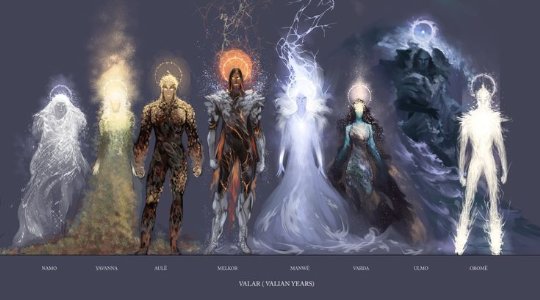
Fan art of the Valar, “Those with Power.” I suggest you read the book to discover their identities and their powers.
Several such open inferences and interpretations of the characters in the story make for an extremely enjoyable read. In my case, it certainly motivated me to explore and learn the details and history of other major religious pantheons that have held power in human history, several of which may also have duly served as inspiration for Tolkien in his writing.
The penultimate theme of the story is the cosmic struggle between good and evil, order and chaos, mirrored in the actions of its characters. The passing of time and the inevitable hand of fate serve as recurring imagery of the circular nature of Tolkien’s world. Even the most subtle decisions made as a result of a character’s emotions, be it pride, vanity, confidence, or grief, result in far-reaching consequences, the ends of which we see resolved in later events of The Hobbit and The Lord of the Rings. While each character is subject to his emotions, those same primal instincts are often presented as the will of a higher being.
As such, an individual’s actions and the dire set of resulting circumstances often provoke the reader to question the morality of Tolkien’s world and its hierarchy. Questions on existentialism and freewill follow hand-in-hand when the reader is left to reflect on the motives and fate of several characters, many of whose lives are quite Sisyphean in nature.
Rock beats Sisyphus.
At the same time, Tolkien also explicitly uses specific characters to fully symbolize prominent themes such as love and hope to counteract the grave world we find in The Silmarillion.
Altogether, the book is a wonderful read, and is a must for LOTR fans. In this brief book review, I have specifically gone to great lengths to not divulge details on the individual characters and myriad stories we find in The Silmarillion. The discontinuous nature of these stories define a fundamental element of the First Age of Middle-Earth which resembles a broken world. I highly encourage both LOTR and non-LOTR fans to give the book a read. As for me, having read The Silmarillion, it is only proper that I now follow through and read the LOTR trilogy, for another collective three book reviews waiting in the future!


 The concept of time has been central to the growth, and evolution of human civilizations. It has also served as an important facet of knowledge that has been studied to a great effect in religion, philosophy, and science. But, to this day, an absolute definition of time still evades scholars.


.jpg)









 The Pensive Reverie