Before quarantine became the new norm, there was a store a few minutes from my apartment that I would frequent on a weekly basis called Wee Book Inn.


A used bookstore, Wee Book Inn was my go-to destination whenever I fancied a random late night walk and on many occasions, casual dates with my partner. (The cat is also awesome.)
Apart from their diverse collection of literature, I was drawn to the venue as they also offered a healthy collection of comic books, often in very good condition, for their modest pricing. Needless to say, I’ve been a ravenous customer, and have trounced on any opportunity to land some good titles. In my efforts to explore the graphic novel medium over the last few years, Wee Book Inn has served as a wonderful resource for inspiration.
My most recent purchase of a collection of William Eisner’s graphic novels was the figurative equivalent of hitting jackpot. Prior to the purchase, I had only ever heard the name “Eisner” as part of the “Eisner Award” winning icon that graced the covers of popular and successful comic books. It wasn’t until after my discovery of the graphic novels that I realized Eisner was a prominent graphic novelist himself (I agree, it’s kinda stupid that I didn’t make this connection beforehand).

So far, I have finished reading two of his titles: Life on Another Planet and The Building. Eisner’s intricate penmanship on top of his unique presentation of panels and sequential storytelling immediately caught my attention. Much of Eisner’s graphic novels were published in the late 1970s in what have been early examples of the American graphic novel medium. In reading his works, it was easy to recognize the foundational aspects of Eisner’s penmanship in modern day comics and graphic novels. His style was reminiscent of the weekly newspaper cartoon strips I had read during my childhood in India.


It came as no surprise to find out that Eisner was also one of the earliest cartoonists to work in the American comic book industry with his earlier series The Spirit (1940-1952) setting a standard in experimentation of content and form in the graphic medium.
It was also easy to recognize the repetitive but endearing theme that characterizes much of Eisner’s works: humanity. Eisner’s graphic novels focus on the human psyche and its vulnerabilities through characters whose worlds seem to be a mote of dust against the larger order that is life.
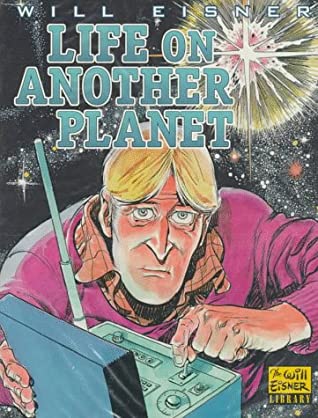
In Life on Another Planet, knowledge of first contact with an alien civilization becomes a reflection of tragic human foibles expressed in the collective and individual responses of governmental organizations, religious pariahs, and all the way down to homeless and impoverished individuals.
Meanwhile, in The Building, Eisner does a reverse sweep in humanizing a building through its relation to the lives of four different characters ranging from an anonymous citizen driven by guilt for the death of a child, a woman trapped in a marriage of convenience, a real-estate developer obsessed with aging, and an amateur musician whose music accompanies the drama of the former trio.

Under the light of current circumstances in our world, the events of Life of Another Planet were eerily relatable. The same could be said of The Building though the readers’ relationship to the characters originate from our personal memories toward past experiences and attachments in life (be it another person or an artifact).
Eisner wrote several graphic novels until his death in 2005. Many of his novels converged in relating the history of New York’s immigrant communities, particularly Jews (elements of which is very notable in The Building). I was also lucky enough to purchase Eisner’s Graphic Storytelling and Visual Narrative where he details his thoughts as a lecturer about the craft and uses of sequential art.
As a student of the graphic novel medium, and as an ardent reader, I would highly suggest Eisner’s works to anyone interested in well-balanced examples of the art of story-telling.




 The Pensive Reverie