Meteors or “falling stars” are an annual visual treat for casual observers and amateur astronomers alike, all around the world. I had my first experience of observing a meteor shower with the Perseids last weekend.
In what turned out to be an unforgettable experience, my girlfriend Leina, and I took a late-night road trip to Prairie Gardens, located near Bon Accord, a small town in central Alberta and an International Dark Sky community.

As a waning gibbous moon rose prominently above the distant horizon, we alighted upon a parking spot near an open field watching the night sky gradually come alive with the familiar band of the Milky Way Galaxy, and the luminous freckles of innumerable stars. Grabbing some popcorn, we would spend the next few hours watching a wonderful show of celestial beauty.
Of course, the night wasn’t complete without a short monologue (thanks to my background in astrophysics) on the phenomenon itself, before the show got underway. I will be treating you, my fellow readers, to the same today while providing further information and resources for all who are interested in catching the next similar astronomical event.
What are meteors?
Meteors are bits of interplanetary material falling through the Earth’s atmosphere. The same objects are also identified as meteoroids while they are hurtling through space, becoming meteors for the few seconds they streak across the sky and create glowing trails. Meteorite essentially refers to the same phenomenon, the major distinction being it is a meteoroid that survives its passage through the Earth’s atmosphere and impacts the planet’s surface.
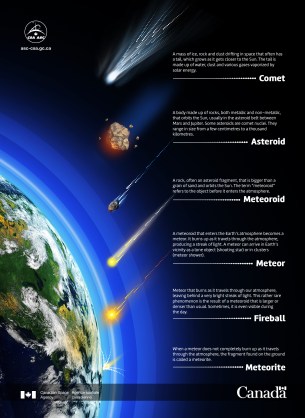
It is estimated that about 44,000 kilograms of meteoritic material falls on the Earth every day. Several meteors per hour can be observed on any given night. It is when the number increases dramatically that these events are termed meteor showers.
What causes a meteor shower?
Taking the Perseid meteor shower as an example, the phenomenon we are observing is caused by the Earth’s motion through the dust and debris left behind by the comet Swift-Turtle, the largest object known to repeatedly pass the Earth. The comet last passed our planet during its orbit around the sun in 1992, and its next visit will be in 2126 (I should be 135 years old then, but don’t worry, I will give you all a heads-up). It is Earth’s passage through the leftover comet debris that results in meteor showers. The Perseid meteor shower is particularly popular, and peaks around August 12 every year. Most of the meteors in the Perseids are about the size of a grain of sand, and rarely make it all the way to the Earth’s surface.
Are there others?
Other meteor showers and their associated comets include the Leonids (Tempel-Tuttle), the Aquarids and Orionids (Halley), and the Taurids (Encke), most of which are modest showers. The Geminids, coming up on December 13, are typically one of the best and most reliable of the annual meteor showers with peak rates of about 120-200 (at best) meteors per hour.

What do you need to see them?
Very simple. All you need to catch the show is darkness, somewhere comfortable to sit, and a bit of patience. The best thing to do is drive away from the city lights, and go to a nice dark place by the suburbs or countryside. Prepare to sit outside for a few hours, and bring some snacks and bug spray. Finally, let your eyes adjust to the darkness, and enjoy the show!
Where can I follow up on all of this?
The World Wide Web is a wonderful resource. Space or Astronomy, and even more obviously, NASA, all provide wonderful updates and articles on the various astronomical events throughout the year. So, whenever you feel like indulging in your inner astronomer, and something out of this world, just check out these resources.
In that vein, I leave you all with a reminder that we do have a solar eclipse coming up tomorrow. The eclipse will primarily be featured across America where people will have the chance to observe a total solar eclipse, while Canada will see a partial solar eclipse. To all my readers in America and Canada, have your eclipse glasses ready for this! To all my readers elsewhere around the world, for more information and live streams, you can always check out: Solar Eclipse!
Happy observing everyone!
 The Pensive Reverie