The art of Kim Jung Gi

For this post, I’m going to go short and sweet by being faithful to the old adage that “a picture is worth a thousand words.”

I came across Kim Jung Gi’s artwork back in 2016 during my first visit to Vancouver B.C. Taking cover from the torrential rain that day, my partner and I entertained a long detour through the Vancouver Art Gallery.

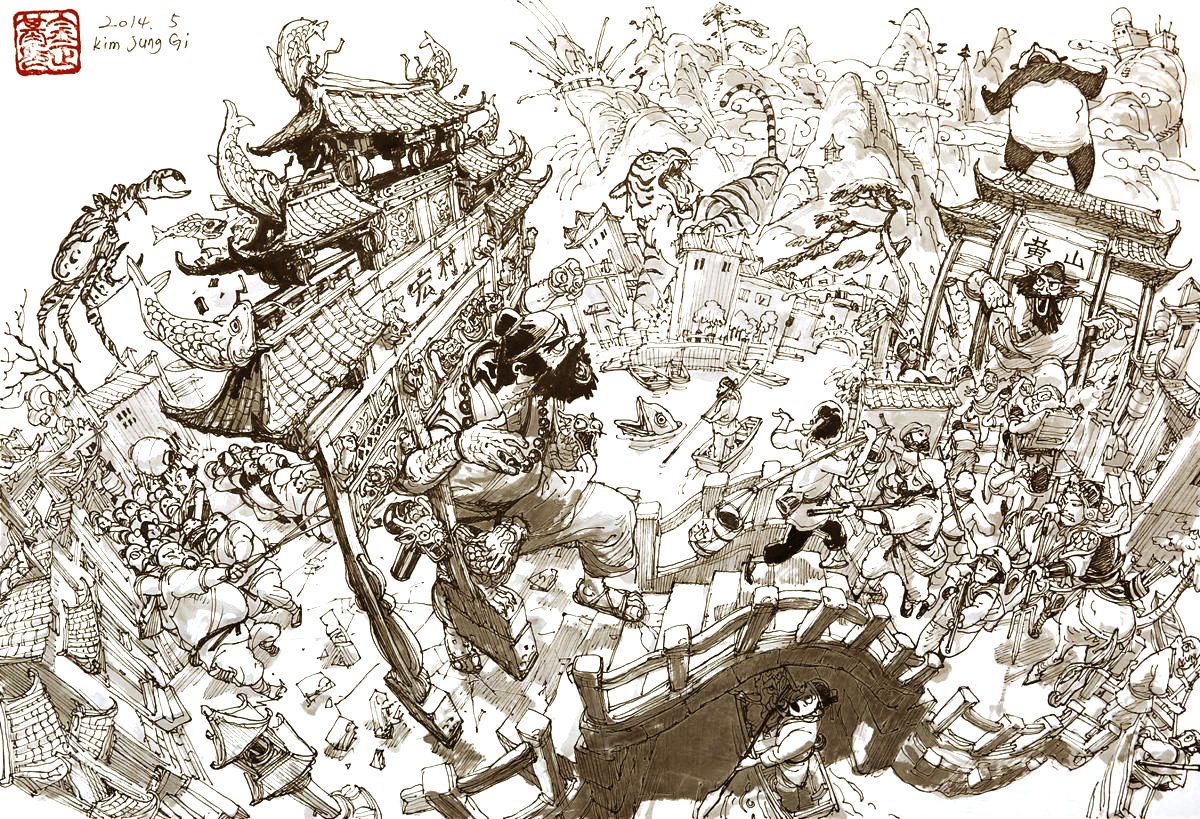
We spent almost two hours walking along the various corridors hosting a massive collection of diverse artists and their works. Our final destination would bring us to the section dedicated to artists within the manga/anime genre, and that is where I came across this,
and many more,

Never had I felt so engrossed into the details of an art piece. The details were dynamic and there were radical shifts from one point to another. Yet, despite these fluctuations, there was also an exceeding sense of balance in Kim Jung Gi’s artwork that provided insight into his creative process from the small to the large.

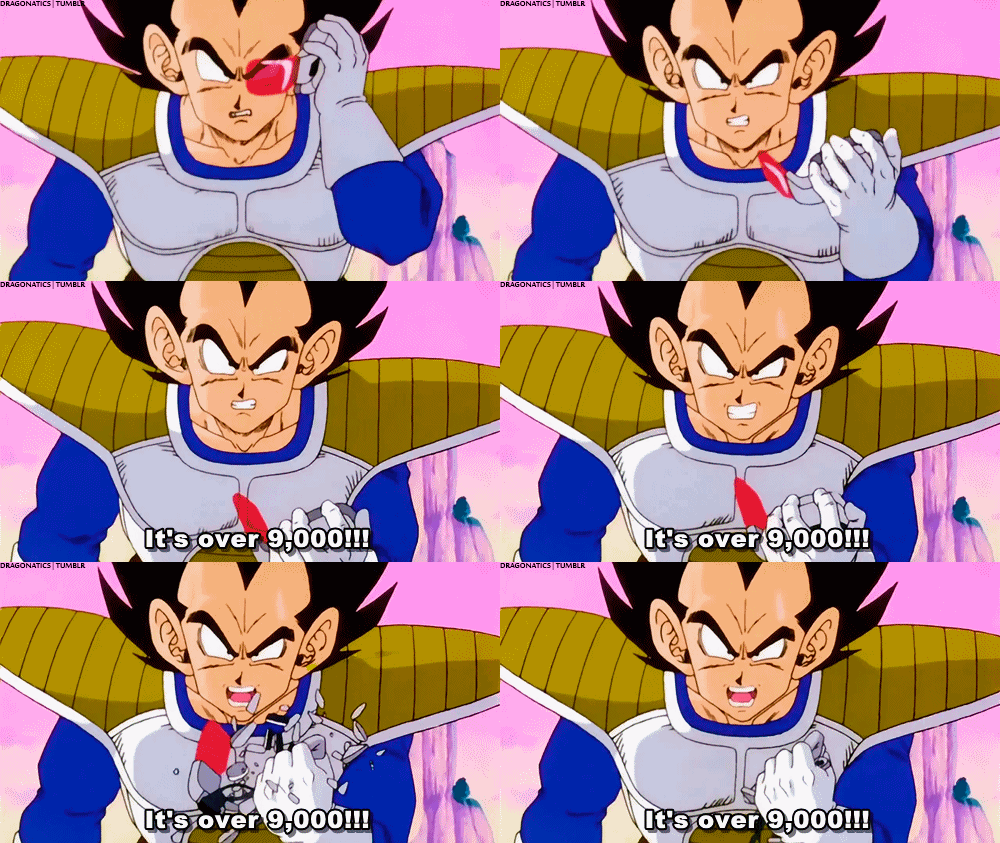
For a guy like me, who loves his astrophysics, this correspondence of the mechanics of the small and large pieces of the work only drew me in further. The gallery had a small TV showing Kim Jung Gi’s approach, and it floored me to see that the man literally drew from memory. Discussing his art work that day,  my partner and I would relate a classic conversation from Dragonball Z as an analogy of Kim Jung Gi’s artistic power levels:

tumblr_m96runst3c1r72ht7o2_r2_500
Me
c65d423e1bfdaa32304dfd4a1ff09800
My partner

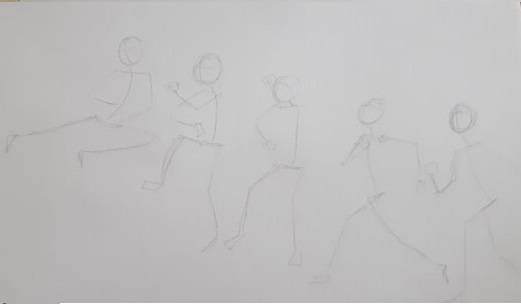
Over the last week, I’ve had a chance to improve a little further in my own journey through figure drawing. 
104947643_554448391857388_5485824118973520966_n
From this…
105538944_266640151087494_979940816938058642_n
To this…

It is in these moments that I draw inspiration from artists like Kim Jung Gi. While his art may be daunting to the eyes of an amateur, I cannot deny that in following up with the man’s biography, what has often been casually cataloged as innate talent, is in fact an amalgamation of hard work, dedication, and perseverance.

There is still a long way to go on the road to mastery as I’ve been told repeatedly by my peers and mentors. At the same, I’ve also been equally advised,

tenor

I guess that’s what makes the whole aspect of it so much fun as by being an artist you get to continually expand your horizons to your personal liking. In the artistic realm, Kim Jung Gi has one heck of a mileage owing to his near crazy dedication to art which he developed as a hobby and now a life-long career. I hope to do the same on my own end, and even if I were to never reach his level, I could say I take satisfaction in the all the minute details of the experience for the larger part of what it is: a story of its own.

For those among my readers interested in finding more of Kim Jung Gi’s artwork, his sketchbooks are an awesome portal into his world.

Adventures in Drawing!

Making good progress on my dreams to be a mangaka in the future, I’ve spent the past two months attending a basic drawing class, and so far, I’m having a blast. This post is dedicated to my fellow amateur artists, or anyone interested in drawing; I thought it would be a worthwhile effort to provide a summary of what I have learned so far, and share my efforts with all my readers.

Art, in general, is a highly subjective field. At the first session, it was a relief to hear my instructor recite the philosophy, “Anybody can learn how to draw,” mentioning that one’s drawing ability isn’t measured by how gifted they are, but is rather a reflection of their perseverance, and efforts to hone their skills.

Though I’m only halfway through the course (four sessions out of eight in total), I’ve learned a lot. Much of this learning has involved the transcription of my observations, and perspectives of a random subject onto a paper, following three fundamental principles of drawing.

Techniques aside,  drawing is the ability to closely observe your subject. It is an exercise in learning to actively see things, and deduce differences.

vlcsnap-00028
Figure 1 – My first work, a shoe!

 Lesson 1 – Learn to actively see things. Figures 1-2 describe this principle. Both figures were drawn within the same period of time, with Figure 1 drawn initially, prior to instruction, and Figure 2, after learning to remediate my ability to observe, and focus on the details of the shoe.  

vlcsnap-00032
Figure 2 – The same shoe, after really learning to observe my subject.

Rather than have a passive approach, I was instructed to use continuous lines, which provided a sense of structure, and certainty to my artwork. Now, drawing a straight line in itself is difficult, continuous lines even more so, and it is here I found the value of repetition.

Lesson  2 The value of repetition. It is imperative that you repeat the exercises you learn in drawing. Figure 3 presents simple exercises in “doodling,” such as drawing circles of varying sizes, and figure eights, using continuous curves (without lifting the pen). Such activities helped with hand-eye coordination, particularly with blind contour drawings. 

vlcsnap-00033
Figure 3 – Part of aggregating your skills in drawing is to practice, repeatedly. 

I spent many an hour practicing my hand/eye coordination by simply doodling around on a piece of paper. This also helped big time in learning to draw with my arm rather than my wrist which is essential when one wishes to draw continuous lines.

Lastly, I was encouraged to draw what I plainly see in my subject, and not give in to the natural urge of presupposing what I believe the subject should be from prior knowledge.

DSC00551
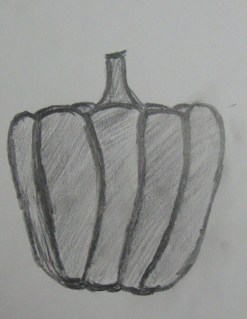
Figure 4 – The botched pepper.

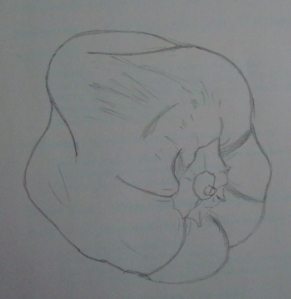
Lesson 3 – Draw what you see, not what you know. This makes a big difference. Figure 4 presents the infamous drawing of a pepper from memory (looks more like a pumpkin). Figure 5 presents a pepper drawn from observation.

Now, does this make a difference when it comes to drawing from imagination. I think it does, but we have to realize that our imagination is in many ways an exaggeration or extrapolation of what we observe in our reality. Learning to draw what I see in reality helped nurture my imagination.

dsc005461.jpg
Figure 5 – Pepper from observation. Seeing versus knowing makes a difference in drawings!

These three principles have formed the foundation of my progress in the class so far. Supplemented by lessons in individualizing one’s artwork, and finding a measure of focus, and shape consciousness (which calls for basic interaction with your subject) my drawings have come a long way (Figures 6-7).

vlcsnap-00034
Figure 6 – A half-finished portrait of Natalie Portman using graphite pencils, cheese cloth, and blending stumps.

DSC00549
Figure 7 – Another exercise in graphite. A portrait of Marcus Aurelius. I’ve still got a long way to go!  

In this review, I wished to provide a generalization of the primary lessons that were essential to getting me started in drawing. Of course, there is always more to learn especially when it comes to the various techniques that can supplement your skills such as the use of guidelines, sighting angles, drawing upside down etc. But ultimately, practice makes perfect.

In my case, drawing has served as an extension to my imagination, as well as an entertaining activity in interpreting the world around me. As an art, it stresses our abilities to interact with the environment using our physical, and mental faculties, providing a medium through which one can express his/her individuality.  Most of  all, it is a lot of fun!

On a conclusive note, for those among my readers who live in Edmonton, I attend my drawing classes at the Edmonton City Arts Center.

cac_facility430w

The course is 8 sessions long, and is well worth the money. The City Arts Center boasts a variety of programs for adults, and children alike. If you’re interested in polishing your basics for drawing, certainly give the Drawing 1 & 2 course a try.

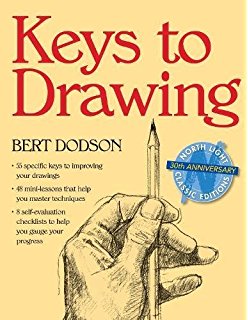
And for my readers who occupy various other corners of the world, but are aspiring artists, I would highly suggest Bert Dodson’s Keys to Drawing.

BertDodson

It is an excellent resource to learn the principles of drawing, and is a great complementary reference for any basic drawing course.