When you arrive at a crossroad in life, you can guarantee that it will come with its fair share of mixed feelings and emotions. The last month has been just that amidst some giant leaps and developments in my personal life, and ergo, my absence from The Pensive Reverie. It has all been about perseverance amidst the changes that I expect moving forward (delightful as they are) in a committed relationship with my partner and one which will invite company in due time.
The experience has had far-reaching implications, often to hilarious effect, in various aspects of my life. From an adventurous sleeping cycle and a total re-organization of daily activities, the last month has kept me thinking if I’m back at the university dorms doing undergraduate studies.
Jokes aside, these recent developments have also led to difficult engagements in other aspects of my life largely revolving around family. Long back, I had written a post titled Constructing an Identitywhere I had identified myself as a third-culture kid.
Much of this was related to my experiences in traveling around the world to different countries throughout my teenage years, and the struggle that accompanied my efforts in balancing my cultural personality. Most of all,
I found the inability to openly discuss individual differences within my culture as a major obstacle in communication. Social interactions would rather become a form of control, followed by an equally weighted concern for internal, and external judgment.
During a pandemic, when you are living in the opposite corner of the world from your family, things get a little difficult. So, needless to say, much of August has also involved a consistent dose of perseverance, now spanning several years, in dealing with tumultuous family dynamics.
Communication can be darn difficult especially in situations where you expect it to be easy. A dollop of a multicultural relationship, topped with differing ideals and perspectives, make the ensuing conversations even more difficult. Despite this, I find it necessary to persevere because after all family is family. August has been fruitful in that I was able to find a measure of closure concerning much of these issues.
With that being said, I will return very soon with a new post and updates about my latest efforts in writing my graphic novel, and artistic adventures.
Firstly, this post doesn’t pertain to any discussion On the Nature of Knowledge. I’m still piecing together my ideas for that post, and will post it later this week. I’m here today to simply talk about the fun I had this weekend revisiting old memories! Just this Saturday, I attended a series of events celebrating Indie Author Day at the Edmonton Public Library.
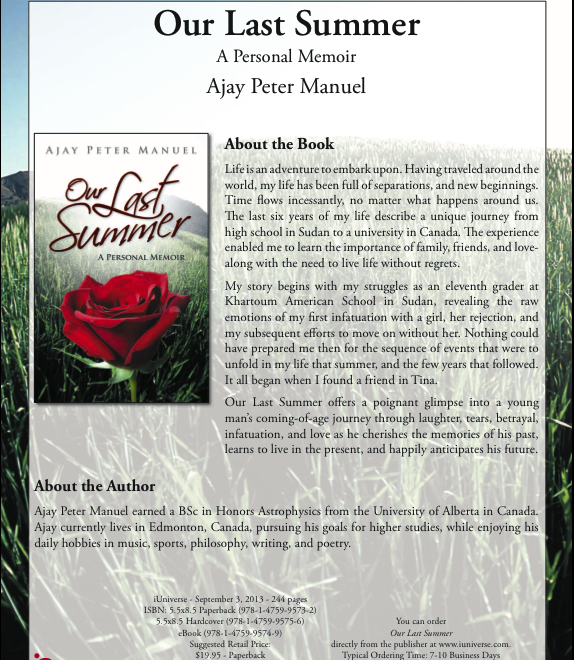
The experience was a lot of fun, and was a motivational reminder on my aspirations to become a successful writer. Having attended a few sessions ranging from discussions on self-publishing, marketing, to friendly advice on just getting your stories heard, I was thoroughly enthused to get back on my writer’s bandwagon by the time I returned home. For those among my followers who may not know, I’m a self-published author. My first book was Our Last Summer: A Personal Memoir detailing my experiences in Sudan where I completed my secondary education. The book is dedicated to my closest friends, in memory of our time together at Khartoum American School (K.A.S.), as well as my loving family.
I started writing the book back in 2009, and it was published around the summer of 2013 after having undergone a tedious but highly enlightening process of editing, book binding, and marketing with the assistance of iUniverse, a self-publishing company. My original intentions were to continuously promote the book afterward and hopefully help in its sales. My earlier blog, ourlastsummer2013, was meant for this. But, life happened, and following the publication of the book, I became quite jaded about writing and myself. I was also enmeshed in my personal identity crisis. Consequently, my promotional efforts were cut short, and I took a break from writing.
Three years down the road, I found myself sitting in a room filled with Indie authors, spending a few hours re-reading the passages in my book, and revisiting many forgotten memories of my past. I had recovered from my identity crisis thanks to my friends, and family, and am now close to completing a second book that has been in the works for two years. By revisiting said memories of a forgotten summer, I was able to reassess my growth as an individual during the last seven years of my life, ever since I commenced my post-secondary education at the University of Alberta. I was also able to recognize the significant influence writing Our Last Summer had in my life, and felt sad that the book never got the personal recognition it deserved from its own author.
Ever since my childhood, I’ve been passionate about two things: learning and asking questions. These two attributes contribute to my personality as an autodidact and have been the main benefactors towards my motivation for higher studies, and academic pursuits in various fields from astrophysics, biophysics, plasma physics, and in the near future, robotics. My academic interests were also complemented by my love for writing, music, and art. Throughout my life, I’ve been able to engage and enhance my creativity and skills in these different subjects.
Having completed my Masters, and on the verge of finishing my second book, I’m now motivated to unite my interests toward a unique career. I have no idea what exactly it will be, but it certainly will have a mix of everything from being a scientist, writer, and an artist. It will be an infusion of the freedom and happiness I’ve found in my writing, engaging my imaginations and bringing them to fruition through my art and music, and sharing my comprehension of what I learn about the surrounding world to my friends, family, and to all of you! Part of that effort will now involve my dedication toward revamping the promotions on my first book Our Last Summer: A Personal Memoir. I will use The Pensive Reverie (and the Facebook group) along with my Twitter account to provide for promotional materials every now and then ranging from tidbits from the book, to free e-book passes, and reviews.
I sincerely ask all those who follow this blog to help and support my efforts by spreading the word as much as they can and getting others to tune in to the blog as well as my book. The book is available online (just Google it), as well as on popular bookstores (Chapters, Barnes and Noble, Kobo etc.) I will provide more info, including some promo materials, and sneak peeks on Our Last Summer along with my next post On the Nature of Knowledge.
Until then, thanks so much everyone, and have a great day!
It is a question that everyone asks at some point in their lives, and characterizes an individual’s struggle to define their identity, relative to themselves, and the world. Understanding this allows one to examine, as well as recognize, their own potential, and qualities as an individual. It is also highly influential in one’s decision on who they choose to be, particularly in relation to their social circumstances.
I’d spent the past week wrestling with this concept, that incidentally suffers heavily from the bias of vague, and open-ended statements. It is also an onerous task to maintain a degree of impartiality in discussing the various facets of a concept that is implicitly co-dependent on the individual, and their environment. Thus, for the sake of brevity, and a measure of focus, I will abstain from a generalized mode of approach, and inject a dose of my personal experience, as a third culture kid (TCK), to guide my review of this subject.
What is a TCK?
A third culture kid is a term used to describe children who were raised in a culture, or an environment outside of their parents’ culture for a significant part of their years of development.
Self-identity is a measure of an individual’s growth, and is paralleled by their personal intelligence. Self-knowledge is the understanding of oneself, and one’s motives, or character. Personal intelligence is the exhibition of this self-knowledge, allowing one to correctly evaluate oneself, and others. Possessing personal intelligence also allows individuals to acknowledge their own limitations.
Altogether, it could be said that this triad of elements, and their dynamics in an individual define his/her personality. An analogy can be made to the form of ideas, and their subsequent expression via actions. The question of identity is a sponsoring thought, precursor to the ideas that form the foundation of our self-knowledge, to ultimately result in the growth of our personal intelligence exercised in our ability to adapt to our environment, and our decisions.
In constructing one’s identity, an individual confronts the objective of maintaining a balance between these three elements, while remaining open to an assortment of external influences that pervade one’s environment. This balance exemplifies the ideal “perfection” that every individual may seek as dictated by the boundaries of their life.
Perfection was of paramount importance to this particular individual.
An Identity Crisis
An identity crisis is not so much a crisis as it is a natural consequence of life. One may experience such an issue at any point in their life, and at times, repeatedly.
In my case, the root of the crisis was in the difference of my views, along with the influx of conflicting “agents” that set about the expansion of my world. It was a process that eventually led me to acknowledge my status as a TCK.
These so-called “agents” were the structures about which my life revolved, and a casual listing of a few would include: culture, religion, family, education, and personal experience. My identity crisis originated from a combination of these factors, and had a significant influence in my mental, and physical maturity.
Every individual we meet in life maintains a unique view of the world, none of them being perfect. At times, we aren’t conscious of this world view, and there is an associated vagueness on the rules that we abide by, or prefer to choose, in leading our lives. Problems in self-identity arise as reason pierces this vagueness that clouds our psyche.
My exposure to a clash of cultures, and my daily interactions during my life at Egypt, Sudan, Sierra Leone, and Canada, the differences in religious rituals, and conversations, the changes in family dynamics as well as the choices made in my personal education, and the acceptance of selective experiences allowed for clarity, and a brand new integrated perspective on the rules, and standards that dictated my life.
My struggle primarily concerned communicating my differing views, and perspectives within the conservative habitat of my family. To call for blame was redundant, and the solution followed the simple necessity of an open conversation, but the path to it was fraught with afflictions of self-doubt, and a gradual disintegration of the boundaries that once delegated my life. I often liken it to seeing the two faces of a coin, describing the dual identity I maintained, while in contention with an objective to delineate the appropriate behavioral balance in between.
What is the bigger picture?
The environment contributed vastly to my progress. My childhood was predominantly in India, in a society that constituted a collective form of individuality, where there is a preference for group mentality, particularly surrounding family relationships. As a ten year old, I was not able to critically assess my status in this culture.
The rest of my life was spent traveling from country to country, completing my secondary education in Egypt, followed by my higher-secondary studies in Sudan. While my family would continue in their collective journey to Sierra Leone, I decided to pursue studies at the University of Alberta, in Edmonton, Canada, and where I am now to this day.
In between these transitions, I slowly confronted the persisting doubts, and questions I had of the various cultures, and communities where I had lived. This led to the conflict between the conservative dynamics of my family, and the open attitude I embraced in my life.
I found the inability to openly discuss individual differences within my culture as a major obstacle in communication. Social interactions would rather become a form of control (abusive or non-abusive), followed by an equally weighted concern for internal, and external judgment. Influence seemed a selective process relegated upon the younger population via the codes of conduct (or ritual) held in high esteem by the older fraternity.
On the other hand, the allure of an open approach towards life, fostered an independent attitude, and relationships. There was an inherent favoritism towards the individual, and his/her actions could reflect along the lines of, “You do what is right for you-haters gonna hate.”
Confronted by these differences, I decided to choose the best of both worlds. It is a choice that I still debate, and contend with. My identity crisis entertains a search for balance between the differing values, and ways of life in the two communities. Neither was perfect, and both had their share of deficiencies, and advantages.
How do we make the right decisions?
It is the final destination. An identity crisis ultimately comes to debating the right course of action. In my opinion, there is no one absolute answer.
The choice of identity is a highly selective, and fast-evolving process. At the end of the day, it really is up to the individual to decide on what they wish to believe in, and the path they choose to pursue.
It would be highly favorable if this decision is made with an open mind that not only acknowledges the compromises that may be made, but also the necessity to remove oneself from an environment that may not be suitable in their lives.
This willingness to separate oneself from their immediate world, can be accompanied by a healthy endeavor to integrate the multitude of perspectives, and views that concern their life.
To what end?
My comments on the prior section may provide an air of selfishness about the individual in choosing their well-being over that of others. In my own life, my choice to follow a unique path was falsely viewed as an act of selfishness. This is very common, as we are after all discussing an issue that pits an individual against his/her immediate environment, and peers. Thus, it is natural to have a difference of views, or a parting of ways among the subjects involved.
Identity is an evolving concept. It is a lifelong transition, and depending on the individual, it may or may not find a resolution. I’m still very much in the process of constructing my identity, and have found my resolve by focusing on my dreams, and aspirations. Compromises have to be made, and is inherent in our struggles to find a place for ourselves in this world.
But, in the end, what matters the most is that we do so being true to ourselves, and who we wish to be. While doubts, and misgivings may persist, it is up to us to keep pushing forward, even when a resolution may not be evident, in this grand adventure that is life, for isn’t that what it means to be human?
We might not be together every day, and the coming of one adventure, may mean the end of another, but no matter what we do, or where we are, the bonds that we have shared with each, and every person along the way will never break. That’s what it means to live free.
To my readers
This post describes my personal opinions on this complex subject. I invite critical comments, and discussions.
As promised, look forward to the first critical article that I intend to post on this blog this weekend! The discussion will focus on addressing, and scrutinizing the psychology, and dynamics involved in the construction of an individual’s identity, as well as the various parameters that play an influence in the process.







 The Pensive Reverie