Comics have always been a part of my life. Rolling back the years to my childhood at my hometown in Madurai, India, I can distinctly remember the excitement I felt every weekend awaiting the delivery of the weekly comics magazines that accompanied the local newspaper.

Siruvarmalar and Thangamalar, the literal translation beings “Kids’ Flower” and “Golden Flower,” provided a mashup of a children’s activity book mixed in with folktales, fables, and short stories presented in the format of a comic book.

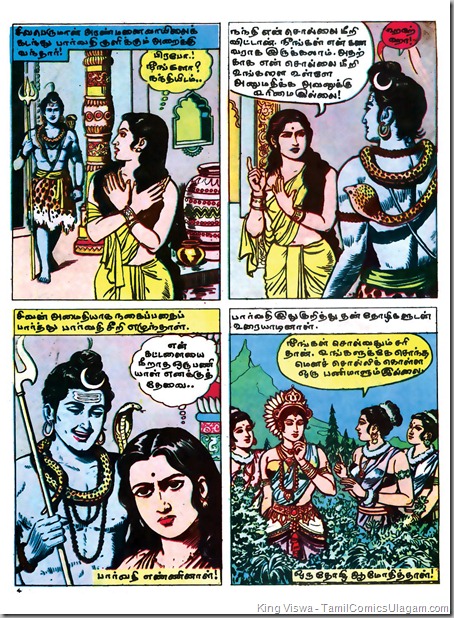
(Left) Sample cover of a Siruvarmalar issue, and (Right) a sample comic strip from within detailing a mythological tale of the Hindu God Shiva. The characters observed are of my native language, Tamil.
I would spend hours on end pouring over the enormous collection of said magazines that my grandfather stored away in his closet, and that would be a weekend well-spent.
My family’s departure from India to Egypt would result in a break of sorts from comics and my full-fledged introduction to their animated counterparts in cartoons and anime. A few more years down the road, and following the commencement of my post-secondary studies at university, I would rekindle my love for comics in Japanese manga, and other Western staples including DC, Marvel, and an assortment of graphical novels.
As an avid comic-book fan and as an aspiring writer, the goal of kick-starting my own comic-book had always been on my mind. Now, two weeks into writing the script for what I hope will be my first graphical novel, I’ve been thoroughly enjoying the diverse challenges that seem to crop up on every front as I try to bring my story together. A large part of these challenges originate from my unfamiliarity in tackling not only a new genre of writing but also a new medium.

So, what have I learned so far:
1. Writing a comic is not exactly the same as writing a novel. They say a picture is a thousand words. That has become the driving motto of my work thus far, being that I spend a lot of my time imagining the outline of my story before settling down on the script. It is like constructing a silent motion film in my mind.
2. Attention to detail is important, but so is also being concise with what you want to convey to your readers. In writing the script, I found my greatest challenge in getting used to the fact that my dialogues would remain in a world separate from the art work that will serve to provide the emotions to my story. Thus, I had to keep my dialogues effective, concise, and kind of resonate with the emotions I wished to convey in the scene.
3. Writing a script may seem relatively easy ONLY at the start. This was somewhat of a lesson in humility. I began with lofty expectations, assuming that I would be able to complete the script to my comic over the period of a weekend. Boy, was I wrong! Let’s give it at the least till the end of summer, or maybe the end of the year.
4. Don’t overthink. Every writer has a quirk that makes them unique. Overthinking may be a popular category for many writers, and I can certainly be counted in that special group. It’s difficult but sometimes the best way to go about writing a script, not to mention a story in general, is to not overthink to the point where you hinder your own writing.
5. Temper your expectations. This is more of a personal challenge, in that I’ve always been the greatest critic of my own works to the point that my expectations get heavier and heavier. In writing my script, on several occasions, I had to step back and tell myself to relax and not place lofty expectations on myself, especially when it was my first outing in a new medium. Most importantly, I’ve learned my lesson in patience and perseverance.
What I’ve said thus far may make it seem that resultant process of writing my novel script has turned me into
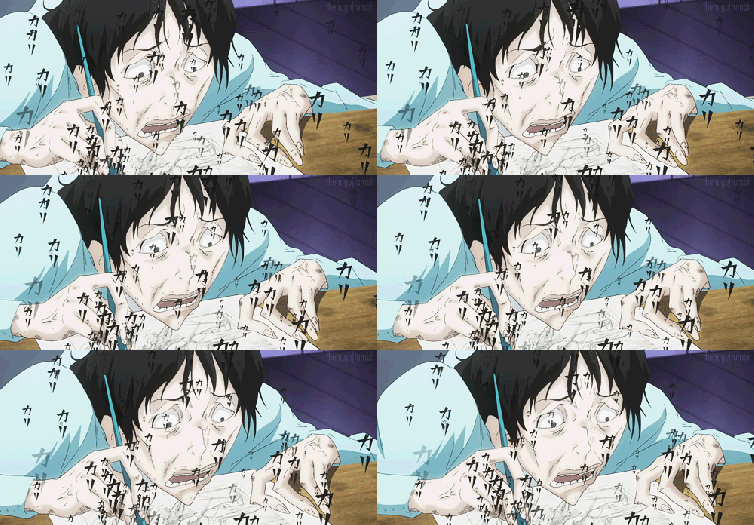
The reality is quite different. As frustrating as the process can be, I’m relishing in the challenge, and it has only motivated me towards my goals. In 2 weeks, I have written 2 chapters, and that’s great while trying on one hand to balance my PhD studies. I hope to keep up the pace, maybe even go a little faster, and keep the ball rolling. Once the script is done, my efforts will be fully directed toward the necessary art work, but that’s a story for another day!
 The Pensive Reverie