First of all, I would like to state that this will be a SPOILER-FREE review. With audiences still pouring in, and only a week since its initial release on October 4, 2019, I felt it best to be tight-lipped about the details and instead provide a general outlook on how my movie experience turned out to be.
As you all know by now, I’m a huge comic-book fan. My loyalties lean toward DC though I also enjoy several titles from Marvel and the MCU. Among the pantheon of DC and Marvel superheroes and villains, Batman and Joker rank as my favorites.
The Joker has been brought to life on the big-screen via the acting chops of several actors including Cesar Romero, Jack Nicholson, Mark Hamill (voice-acting), Heath Ledger, Jared Leto, and now in Joker, Joaquin Phoenix. Being a huge fan of Ledger’s work in The Dark Knight and after the promising trailer for Todd Phillip’s Joker, I had some pretty high expectations walking into the theater.
Joker met my expectations and even more. In short, Joaquin Phoenix hit it out of the park. Two hours later, as the credits swung over the screen, I couldn’t help but feel elated about revisiting some of the best titles in the Joker compendium, many of which served as subtle inspirations for various elements in the movie.
Joker does not match the present stereotype of popular action-oriented comic book movies and is vastly different in the portrayal of its pivotal character compared to The Dark Knight. Phoenix’s performance serves more as a character study of a super-villain, whose psyche has thus far been explored at least in the context of movie adaptations, from the perspective of his rival, the Batman. This trope is overturned in the Joker where we get a tour-de-force of his psyche in what can only be described, as Batman himself put it in The World’s Finest, “With the Joker, expect the unexpected.”
Joker presents a world in limbo largely framed within the closets of Arthur Fleck’s unhinged mind. It is a world where truth and falsity, reality and illusion all coexist making the audience’s perception of the character vary wildly from pity, remorse, fear, and a certain sense of justice. These emotions are further amplified by Phoenix’s portrayal of the Joker as a reflection of the society in what serves to be a glorious “killing joke” of Arthur Fleck’s descent into insanity.
While it still remains up in the air if this particular rendition of the Joker will carry over into the DCEU, its a promising run of the major titles that DC have released with Wonder Woman, and Aquaman. Joker is a must-watch for all comic book and neutral fans alike. In my humble opinion, Joker ranks on par with Christopher Nolan’s The Dark Knight (though in very different ways) and is an enthralling, curious, transcending, and riveting journey and study of one of the most iconic super-villains ever created in popular culture.
The last month of pseudo-relaxing has followed a successful reset of my PhD research accompanied by a boatload of reading of graphic novels and comic books. Marvel’s Endgame was the initial spark that set ablaze my voracious appetite on revisiting various titles from the past. While Endgame signaled
in the marvel cinematic universe (MCU), a moment met by mixed emotions among the fans, I was glad to move on from what was a decade of movies and get back to roots with the comics that had been in my reading list for several years.
This would be most apt for fans of Captain America and Iron Man.
Although I lean more towards DC as a comic book fan than Marvel, I have thoroughly enjoyed reading stories from both universes. Considering the recent MCU releases, I found an obvious choice to begin with The Infinity Gauntlet, following which I have been on a blatantly biased run of DC titles. But at some point, you need to call a break and get your head out of the books, so I’ve decided to use this opportunity to briefly review the titles I’ve read thus far for both the experienced and amateur comic book fans among my readers.
While Marvel and DC have both gone through major relaunches of their respective universes over the recent years (New 52, DC Rebirth, Marvel Legacy) the titles I have chosen to review predate these events, and involve a mix of standalone novels that serve as perspectives into leading characters from the respective universes as well as sagas that span lengthy series.
The Infinity Gauntlet
If Thanos in MCU’s Infinity War was draped in shades of an anti-hero or a pragmatic villain, the Thanos of The Infinity Gauntlet identifies strongly with his sobriquet of The Mad Titan. The Infinity Gauntlet is the stage of a climactic struggle (and yet the first of many to follow) that pits the Avengers and literally all of Marvel’s pantheon of heroes and cosmic entities against the Mad Titan in the backdrop of what is largely a friend-zone drama between Thanos and the female entity that is Death. To capture the heart of his eternal love, we follow Thanos in what is an enjoyable and at times weirdly comical adventure that pits the balance of the universe at stake.
Superman: Red Son
Swinging into the DC universe, we have a title that is literally one of the best stories in the history of the Man of Steel. Superman: Red Son is a groundbreaking title from DC with a twist on the familiar tale of a Kryptonian rocketship that crash-lands on Earth carrying an infant who will one day become the most powerful being on the planet. Rather than being raised in Smallville, Kansas and become a hero who fights for “…truth, justice, and the American way,” in Red Son, Superman finds a new home in the Soviet Union where he becomes “…the Champion of the common worker who fights a never-ending battle for Stalin, socialism, and the international expansion of the Warsaw Pact,” making us all look up toward the skies and say, “Look! Up in the Sky! It’s a bird! It’s a plane! It’s…Russian Superman!”
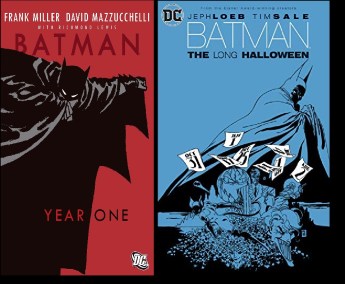
Batman: Year One & Batman: The Long Halloween
A foil to Superman in many ways, Batman ranks among the most popular superheroes of the DC medium. Written by Frank Miller, shortly after the publication of The Dark Knight Returns (a storyline that inspired several sequences in Christopher Nolan’s The Dark Knight trilogy), Batman: Year One is another reinterpretation of a classic hero, and provides a detailed perspective on his origins, the humanity behind the caped crusader’s rationale, as well as his struggles, and growth to become the seemingly invincible hero we know him to be.
The end of Batman: Year One (1986) transitions perfectly into Batman: The Long Halloween (2011) where we follow a compelling adventure in Batman’s early career. The humanity of the Dark Knight, often overlooked by most readers, is in plain view in a story where Batman confronts a former friend turned foe in Harvey Dent.
‘I believe in Harvey Dent,” a line repeated frequently to great purpose in The Long Halloween.
Alongside Superman: Red Son, these two titles hold up as great standalone stories that focus on the inherent humanity and fragility behind the essentially unbreakable beacons of justice, and truth these characters serve to be, making them suitable for amateur comic book readers.
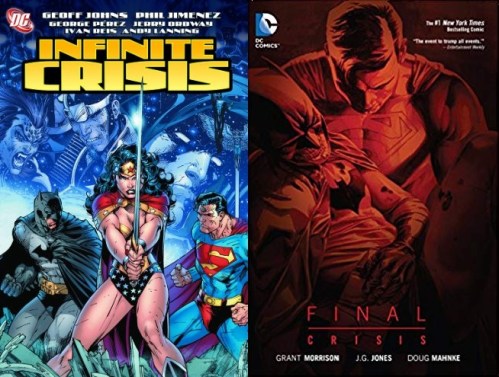
Infinite Crisis & Final Crisis
Rounding off this blog post, we have two more titles that serve as DC’s counterpart to Marvel’s The Infinity Gauntlet. Infinite Crisis and Final Crisis span events that can be considered as the DC Universe’s darkest days. Infinite Crisis serves as a lead-in to the events of Final Crisis. In both cases, our heroes are faced with crises of cosmic proportions that bring together many familiar and unfamiliar faces in the pantheon of DC heroes.
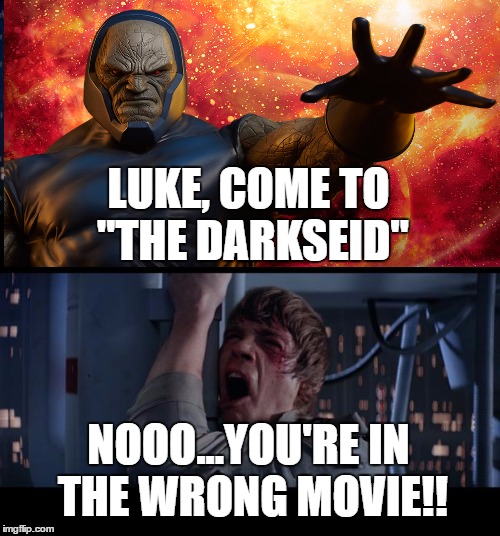
Infinite Crisis highlights a critical moment that has divided Earth’s three greatest heroes: Superman, Batman, and Wonder Woman. As such, the burden falls upon long-lost heroes from the past and other less recognized faces from the DC pantheon to set things straight in a crisis that spans infinite universes. On the other hand, Final Crisis follows the efforts of DC’s “Thanos” (but much better, in my humble opinion) Darkseid who takes advantage of the fallout from the prior crisis and decides to remake reality and the universe in his dark image.
Both Infinite Crisis and Final Crisis are among the last set of publications that preceded DC’s ultimately unsuccessful relaunch in the New 52, and their stories involve hero slug-fests and bouts on a global and universal scale. While these two titles would be most suitable for the well-versed DC fan, the stories are nonetheless a joy to read through for the pure fun, and escapism they provide into the world of DC’s superheroes.
Pretty similar to what Darkseid essentially tries to achieve with the anti-life equation in Final Crisis.
This completes my reviews of the works I have read so far. I’m pretty sure the coming week will see another visit to the public library as I strive to go through the remaining books in what seems to be my endless reading list. See you all next week!
Comics have always been a part of my life. Rolling back the years to my childhood at my hometown in Madurai, India, I can distinctly remember the excitement I felt every weekend awaiting the delivery of the weekly comics magazines that accompanied the local newspaper.
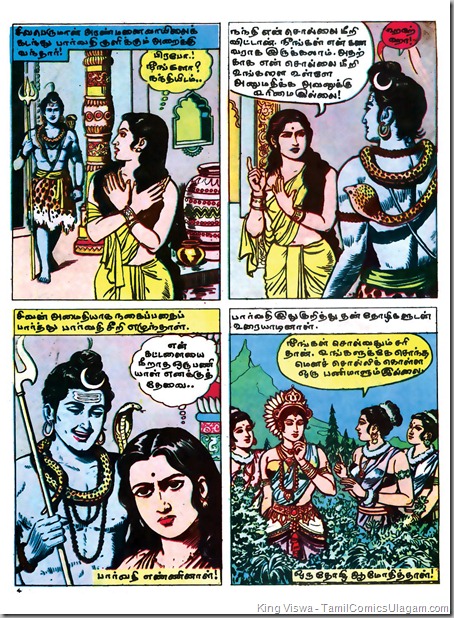
Siruvarmalar and Thangamalar, the literal translation beings “Kids’ Flower” and “Golden Flower,” provided a mashup of a children’s activity book mixed in with folktales, fables, and short stories presented in the format of a comic book.
(Left) Sample cover of a Siruvarmalar issue, and (Right) a sample comic strip from within detailing a mythological tale of the Hindu God Shiva. The characters observed are of my native language, Tamil.
I would spend hours on end pouring over the enormous collection of said magazines that my grandfather stored away in his closet, and that would be a weekend well-spent.
My family’s departure from India to Egypt would result in a break of sorts from comics and my full-fledged introduction to their animated counterparts in cartoons and anime. A few more years down the road, and following the commencement of my post-secondary studies at university, I would rekindle my love for comics in Japanese manga, and other Western staples including DC, Marvel, and an assortment of graphical novels.
As an avid comic-book fan and as an aspiring writer, the goal of kick-starting my own comic-book had always been on my mind. Now, two weeks into writing the script for what I hope will be my first graphical novel, I’ve been thoroughly enjoying the diverse challenges that seem to crop up on every front as I try to bring my story together. A large part of these challenges originate from my unfamiliarity in tackling not only a new genre of writing but also a new medium.
It’s a steep learning curve, but one worth embarking on.
So, what have I learned so far:
1. Writing a comic is not exactly the same as writing a novel. They say a picture is a thousand words. That has become the driving motto of my work thus far, being that I spend a lot of my time imagining the outline of my story before settling down on the script. It is like constructing a silent motion film in my mind.
2. Attention to detail is important, but so is also being concise with what you want to convey to your readers. In writing the script, I found my greatest challenge in getting used to the fact that my dialogues would remain in a world separate from the art work that will serve to provide the emotions to my story. Thus, I had to keep my dialogues effective, concise, and kind of resonate with the emotions I wished to convey in the scene.
3. Writing a script may seem relatively easy ONLY at the start. This was somewhat of a lesson in humility. I began with lofty expectations, assuming that I would be able to complete the script to my comic over the period of a weekend. Boy, was I wrong! Let’s give it at the least till the end of summer, or maybe the end of the year.
4. Don’t overthink. Every writer has a quirk that makes them unique. Overthinking may be a popular category for many writers, and I can certainly be counted in that special group. It’s difficult but sometimes the best way to go about writing a script, not to mention a story in general, is to not overthink to the point where you hinder your own writing.
5. Temper your expectations. This is more of a personal challenge, in that I’ve always been the greatest critic of my own works to the point that my expectations get heavier and heavier. In writing my script, on several occasions, I had to step back and tell myself to relax and not place lofty expectations on myself, especially when it was my first outing in a new medium. Most importantly, I’ve learned my lesson in patience and perseverance.
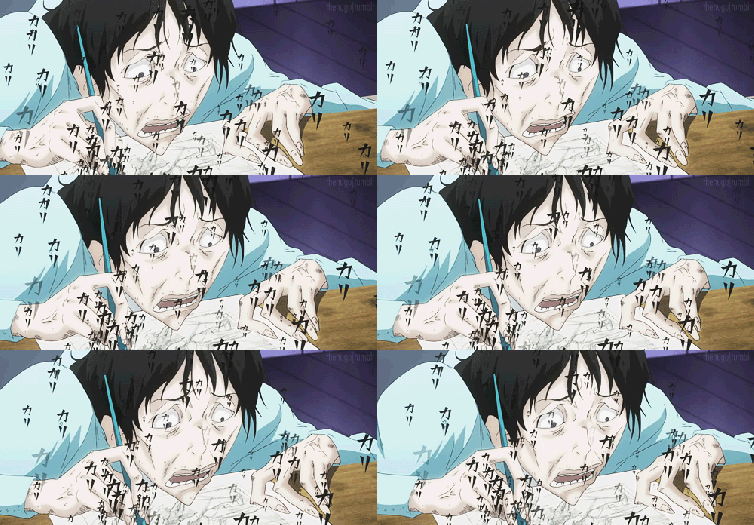
What I’ve said thus far may make it seem that resultant process of writing my novel script has turned me into
The reality is quite different. As frustrating as the process can be, I’m relishing in the challenge, and it has only motivated me towards my goals. In 2 weeks, I have written 2 chapters, and that’s great while trying on one hand to balance my PhD studies. I hope to keep up the pace, maybe even go a little faster, and keep the ball rolling. Once the script is done, my efforts will be fully directed toward the necessary art work, but that’s a story for another day!






 The Pensive Reverie