William Erwin Eisner – A Perspective

Before quarantine became the new norm, there was a store a few minutes from my apartment that I would frequent on a weekly basis called Wee Book Inn.

A used bookstore, Wee Book Inn was my go-to destination whenever I fancied a random late night walk and on many occasions, casual dates with my partner. (The cat is also awesome.)

Apart from their diverse collection of literature, I was drawn to the venue as they also offered a healthy collection of comic books, often in very good condition, for their modest pricing. Needless to say, I’ve been a ravenous customer, and have trounced on any opportunity to land some good titles. In my efforts to explore the graphic novel medium over the last few years, Wee Book Inn has served as a wonderful resource for inspiration.

My most recent purchase of a collection of William Eisner’s graphic novels was the figurative equivalent of hitting jackpot. Prior to the purchase, I had only ever heard the name “Eisner” as part of the “Eisner Award” winning icon that graced the covers of popular and successful comic books. It wasn’t until after my discovery of the graphic novels that I realized Eisner was a prominent graphic novelist himself (I agree, it’s kinda stupid that I didn’t make this connection beforehand).

Will Eisner - Wikipedia

So far, I have finished reading two of his titles: Life on Another Planet and The Building. Eisner’s intricate penmanship on top of his unique presentation of panels and sequential storytelling immediately caught my attention. Much of Eisner’s graphic novels were published in the late 1970s in what have been early examples of the American graphic novel medium. In reading his works, it was easy to recognize the foundational aspects of Eisner’s penmanship in modern day comics and graphic novels. His style was reminiscent of the weekly newspaper cartoon strips I had read during my childhood in India.

It came as no surprise to find out that Eisner was also one of the earliest cartoonists to work in the American comic book industry with his earlier series The Spirit (1940-1952) setting a standard in experimentation of content and form in the graphic medium.

It was also easy to recognize the repetitive but endearing theme that characterizes much of Eisner’s works: humanity. Eisner’s graphic novels focus on the human psyche and its vulnerabilities through characters whose worlds seem to be a mote of dust against the larger order that is life.
1209837._SX318_

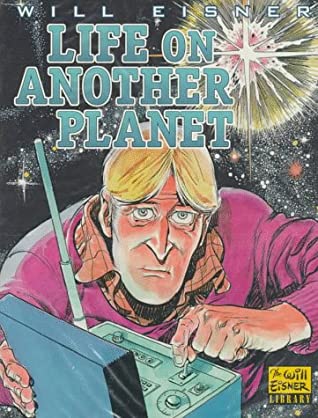
In Life on Another Planet, knowledge of first contact with an alien civilization becomes a reflection of tragic human foibles expressed in the collective and individual responses of governmental organizations, religious pariahs, and all the way down to homeless and impoverished individuals.

Meanwhile, in The Building, Eisner does a reverse sweep in humanizing a building through its relation to the lives of four different characters ranging from an anonymous citizen driven by guilt for the death of a child, a woman trapped in a marriage of convenience, a real-estate developer obsessed with aging, and an amateur musician whose music accompanies the drama of the former trio.

1535935._SX318_

Under the light of current circumstances in our world, the events of Life of Another Planet  were eerily relatable. The same could be said of The Building though the readers’ relationship to the characters originate from our personal memories toward past experiences and attachments in life (be it another person or an artifact).

Eisner wrote several graphic novels until his death in 2005. Many of his novels  converged in relating the history of New York’s immigrant communities, particularly Jews (elements of which is very notable in The Building). I was also lucky enough to purchase Eisner’s Graphic Storytelling and Visual Narrative where he details his thoughts as a lecturer about the craft and uses of sequential art.

As a student of the graphic novel medium, and as an ardent reader, I would highly suggest Eisner’s works to anyone interested in well-balanced examples of the art of story-telling.

Nostalgia – A Celebration Of The Past

Listening to music is a favorite pastime of mine when it comes to sitting in front of my computer and writing away my thoughts be it my journal, my novels, or just plain old school work. I don’t necessarily identify with any particular genre of music (vocal and instrumental alike), and as such go with any piece that suits my mood further aligning with the fact that my selections vary wildly from artist to artist.

Over the last few weeks, my efforts have predominantly revolved around the completion of a literature review about my PhD research. I completed the draft just a few days back. Relishing in the bout of relief that ensued, I lounged back into my chair while listening to a randomized instrumental playlist on YouTube. I would soon alight upon a particular piece that would kindle the memories of my past, drawing my eyes back to the screen of my laptop, where I was welcomed by the opening to a show I had watched in my childhood.

It didn’t take long for my bout of relief to transform into one of nostalgia. Indulging in the bittersweet bliss of the feeling, I sank into the warm and fuzzy emotions of fond memories from my past, subsequently delving into the late hours of the night on a marathon of memories that took me over. This particular scenario was most apt, relating to my earliest inspirations that engaged my creative skills and fueled my love for writing and music, namely, Cartoons from the 1990s. In that vein, I could relate, or for lack of a better word, restrain myself to a few cartoons that struck my nostalgic chords the most all the way back to my childhood, long before anime ruled the roost of my creativity.

It all began on a sunny day jog back home from school to meet my two friends, Christopher Robin and Winnie-The-Pooh. 

This would officially be the first of the may cartoons I ever watched as a kid, taking me back to my days in my hometown in Madurai, running home from school, only to sit down in front of the TV and share in the whimsical adventures of my two friends Christopher Robin and Winnie-The-Pooh.

We would also be joined by two other friends from the distant lands of Arabia: Aladdin and Genie.

With no idea of how vast the world was at such a young age, these four would be a large part of my childhood where I learned to

and when it came to being a mischievous kid  that

all in the time-span of an hour’s limited streaming of cartoons on the single channel that ran on the T.V.

Soon, I would be lucky enough to have my chance to explore the world when my family first moved to Egypt. This time there were two T.V.s in the house though the cartoons were still a limited treasure to come by.

The cartoons would usually broadcast around a three hour session early every Saturday morning when my baby sister (half-asleep most of the time, if I may add) and I would sneak over to the T.V. room while our parents were fast asleep. This time my adventures would alternate between outer-space and our planet as I accompanied Flash Gordon and his crew (the animated feature of 1996) hovering over to futuristic and past timelines with good family friends in the Flintstones (celebrating Christmas before the birth of Jesus Christ), the Jetsons (who would be the preface to my own experience of the technology boom that followed the late ’90s), and a pinch of freakishness to add to the concoction in the Addams Family.

Along with a whole host of other characters each with their singular adventures, I would find myself surrounded by an ever growing family of friends who served as my inspirations in the Cartoons I watched as a kid.

You had the anthropomorphic cats T-Bone and Razor from Swat Kats, who were my first taste of being a legitimate bad-ass, to the incredibly fun Mystery Inc. gang and their impressively subtle mysteries, as well as a slew of others from the manly Centurions, the infuriating Dee-Dee from Dexter’s Laboratory, and the Elvis Presley of Cartoon characters, Johnny Bravo, of whom my mother wasn’t necessarily a fan (in retrospect, I could see why), and his far more adventurous and wiser cousin in Johnny Quest.

But everything that has a beginning has an end, and so as the years passed I would soon find other interests that would catch my attention.

Diverting as I did from the cartoons of the yester-years, I would delve into anime and other forms of entertainment in a world that gradually evolved into a social media frenzy. But that transition is indeed what makes those very memories so nostalgic.

Funnily enough, I’m now at a stage in my life where as I ponder about the future, I only seem to find more pit-stops where I visit and relish the company of the friends of my past. I would have never known then as a kid that one day I would aspire to become a writer/artist, and here I am following in the footsteps of my dreams propelled by those very same inspirations of the past.

Though life is an adventure filled with beginnings and separations, nothing can deny the eternity of memories, and in that sense, this bout of nostalgia was in essence a celebration of the past, and a merry precursor to the good weekend’s rest that has followed!