Touching base with Pencil and Paper

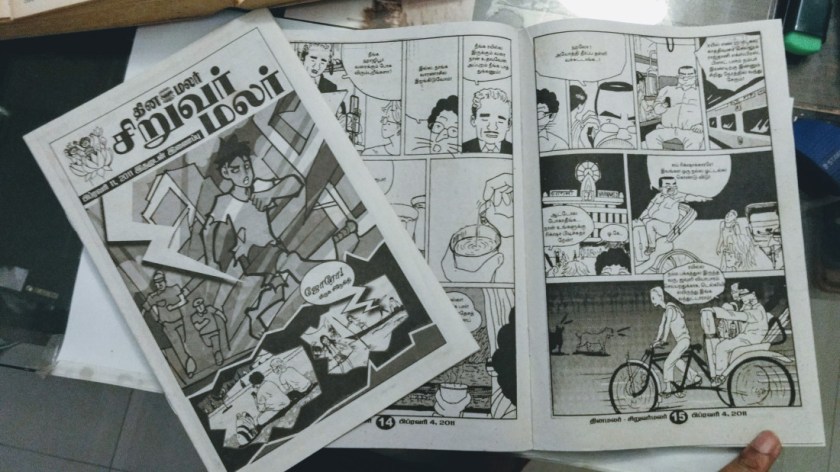
When I was young, I spent a good chunk of time at my grandparents. It helped that their house was situated right next to ours, and my grandfather’s collection of weekly kids comics and magazines were an abundant source of entertainment and inspiration for the kid in me.
img_20170505_191214596
My grandfather collected enough of these that we probably had over 500 of these thin magazines stacked up in a corner of the storage room.

Drawing came naturally to me back then, and I took any chance with a blank paper to draw whatever caught my eye. My grandfather fueled my imagination by sharing folk tales of old and just about everything that he knew while my grandmother indulged me with all the treats she could make to keep me energized with a full tummy.
11
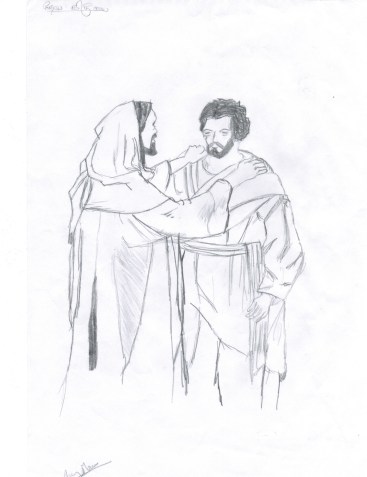
Being a Christian, my grandfather often shared his unique perspectives on the Bible. As a kid, the stories came off more as an epic fantasy, leading me to draw this rendition of Jesus and Simon Peter, no doubt referenced from an illustrated bible at his home.

As the years passed, my interest in drawing gradually took a backseat to my newfound love for writing. Rather than transpose what I felt was a simplified projection of my imagination onto paper, I felt it better to immerse in my imagination as a whole through writing. I was naive to think that between writing and art, one was lesser than the other.

Now, I have come full circle in realizing that art and writing are just two faces of the same coin. It is particularly sweet that I struck upon this knowledge in the process of completing the script to the graphic novel I have been developing over the last two years, and intend to dedicate in memory of my grandfather.

I have spent the last few weeks touching base with old friends in Pencil and Paper. It has been a difficult reunion to say the least, but we are gradually patching a decade of our on-and-off relationship in a newfound resolve to build a strong foundation for the future.

Frustration has been a loyal companion, but I’ve also used it as a source of motivation.

Firstly, I had to start by identifying the relevant skills I required to transition into the “graphical” aspect of my graphic novel. Phase Infinity, as I now call it, has all the characteristics of a long and arduous journey through diverse art courses intended to boost my amateurish skills while simultaneously churning out the artwork for my graphic novel.

To be honest, I find the final product to be a goal for the distant future. This isn’t necessarily discouraging as it is my first attempt after all. What has been annoying though is the persistent need to be overly critical about my work and for lack of any other word, too stiff and tight about my daily progress.

Figure drawing is my first priority as of this moment, and I have been enjoying it in all its gestures and forms. Consistency is the word for the rest of my year, as I hope to amass daily practice sessions.

Steve Huston has been my hero on this front, and I highly advice his books to my fellow artists among my readers.

Learning the human anatomy from an artistic perspective has also opened the door to some philosophy. Gesture drawing, in particular, has helped me embrace the fluid nature of our environments and our very bodies. For someone who has been enamored with the axiomiatic logistics of science and mathematics over the last decade or so, figure drawing has provided a refreshing, and new perspective of the world and its motions and rhythm.

Being a fan of Bruce, these two messages which aligned with the philosophy of gesture drawing became de facto screensavers in my mind throughout my artistic process.

That is all for today! I will keep you all updated with my struggles in art-realm over the coming weeks by sharing some of my art work in the Art Corner, as well as a review in my next post of one of my favorite artists in Kim Jung Gi.
Adventures in Drawing – A New Beginning

Previously on “Adventures in Drawing,” I discussed several matters of art. I specifically placed emphasis on the three valuable lessons of learning to actively see thingsthe value of repetition, and drawing what one sees, not what one knows.

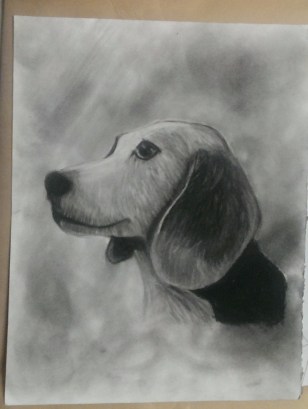
The second half of the drawing course followed the application of said rules with a series of projects. I had the wonderful opportunity to test my skills with various mediums from charcoal, graphite, and conté sticks. Along for the ride came an assortment of healthy drawing techniques I had learned earlier involving the use of guidelines, the ability to delineate depth and active perception in objects, as well as blind contour drawing etc. All in all, I thoroughly enjoyed the opportunity to test my skills with the various media (Figures 1-2).

Figure 1. Man’s best friend (using charcoal, and graphite). 


Having completed the course, I can certainly say that my knowledge, and library of resources pertaining to drawing has grown exponentially. If there is a takeaway message from my experiences so far, it would be the following: simply put, anyone can be an artist. All you need is an HB pencil, a sketchbook, and a little bit of incentive. Most importantly, practice makes perfect.

In my opinion, I view drawing, and art, in general, as a personal interpretation of one’s environment, and imagination; a realm of infinite possibilities. The uniqueness factor of one’s works is dictated not through the judgment of external critics but rather one’s own individuality. Thus, you have nothing to fear in the criticism of your own doodles. We are all artists in our own measure. As Mason Cooley put it, “Art begins with imitation, and ends in innovation.”

Figure 2. Unfinished swimmer (using conté sticks)

With every passing day, I get closer to achieving the same with my artwork. Once again, I’ve learned that practice makes perfect. (On a side note, it also helps to have an encouraging partner, especially one who goes out of their way to buy you a legit Japanese manga kit but I digress.) If I could briefly summarize the steps that I have taken so far in my journey in drawing, and that I wish to share to my fellow aspiring artists, they would be:

(1) Start with doodles, and doodle frequently. Sketch whatever you wish to sketch. Freedom of imagination, and action is important in drawing.

(2) Get a few guide books on the side, or even better, just parse through the overwhelming history of artists, and their works that we can readily find information about on the WWW (world-wide-web).

(3) Trying a short, and supplementary course is highly beneficial too. Learning drawing also involves the communication of ideas, and techniques. (Check out the arts center in your city. If you don’t have one, Udemy is a wonderful online resource for awesome, and cheap courses. And if that doesn’t work, then it’s even more simple, learn from nature, and become your own artist. There’s no limit to human creativity, and imagination.)

(4) Aggregate the lessons you learn in infinitesimal steps, and integrate them toward a full learning experience.

Moving on from here, I intend to eagerly pursue my dream of becoming a mangaka in the future. For those among my readers who are avid comic fans, and are particularly interested in making their own comics, I highly suggest the constructive anatomy, and figure drawing books written by Burne Hogarth, and George Bridgman (shown below) to get you started.

But after all is said, and done, remember to relax, and just have fun with it!

b213b41e0994cef2104f5f8dbff5fb00a437211b2eec08212df63096b798cee0