It has been an ascent of Sisyphean proportions to the summit of publishing my book, and the journey’s end is now in plain sight. Having toiled persistently, I have pushed against the heavy boulder of formatting, and have finally alighted upon the stage of approving the final proof of the book before it is on its way for publication.
The book will be published in both paperback, and e-book format (thus, the delays and exponential workload in formatting). But, patience is a virtue. Being the perfectionist I am, I want my work to be published at its best quality, and so we continue with this waiting game temporarily. Independent publishing certainly keeps your hands full but it is a wonderful feeling once your book is out. At the least, another week remains before the official date of publication.
Having been so focused on the publishing business, I’ve had little time to post anything new and interesting on the blog, and I apologize for this. While I wait for the proof copy of my paperback to arrive at my doorstep, I will get back on those posts I promised earlier. In fact, I hope to have one up by tomorrow evening, where I will detail my most recent adventures in observing the Perseid meteor showers.
I thank all my readers for their patience. You guys are the best!
It is a necessary step, but formatting is possibly the most irksome part of publishing a book. That’s pretty much where I’ve been in the last two weeks, wading through a murky swamp of page breaks, indentations, paragraph spacings, margins etc. Having completed the illustrations, along with the cover art for my book, I spent an entire week polishing said images to fit the prerequisite conditions for publication.
As of now I’m alighting upon the final few steps before clicking on that beautiful button “Publish” on my screen. I’m hoping to have the book out by next week, and prior to release, I will provide full details on the work (along with promotions), including where it will be available, and how you, my wonderful readers can get your hands on it. Following the publication, I intend to continue promoting the book on the blog, while getting back to the posts I had planned earlier.
I thank everyone for being patient, and I look forward to sharing my work with you very soon!! Have a great weekend!!
Luc Ferry’s A Brief History of Thought recently caught my eye as I wandered through the library. The book promised a brief summary of human thought and its evolution across significant historical epochs within a meager volume of pages. Who wouldn’t wish to entertain such a prospect?
The book’s strength is in Ferry’s ability to summarize various complicated worldviews with such simplicity, and conciseness. While I can’t call upon an extensive knowledge of philosophy to critique Ferry’s work, I certainly identified my share of agreements and disagreements with the opinions and perspectives proposed in the book. In this review, I will summarize Ferry’s claims and arguments, which while insightful and highly educational, personally, fell short of convincing by the final pages.
Ferry begins by addressing the question at the heart of human existence, a quest for salvation (an answer to the mystery that is death), which he identifies to be the vital aspect of every philosophical system. Characterizing philosophy as more than an act of reasoning and logic, Ferry asserts that philosophy is also a measure of human thought that “claims to save us – if not from death itself, then from the anxiety it causes, and to do so by the exercise of our own resources and our innate faculty of reason.”
From there on, Ferry uses this argument as a guide to expound his views and perspectives on the various philosophical movements that have spanned the history of human thought: Stoicism, Christianity, Humanism, Postmodernism (Nietzsche), and Contemporary philosophy (post-Nietzsche). The book flows smoothly from one time period to another while providing an effective summary of the relevant aspects of each philosophical movement. By the end of each chapter, the reader is able to identify the questions and answers that serve as the foundation for the consecutive movement.
We are first acquainted with the Greeks and their establishment of Stoicism, the representation of the world as a perfect cosmos, an ordered logos where transcendence and immanence are united; a cause that the human strives to be a reflection of.
Cosmos refers to the explicit complexity, and perfection of the external universe. Logos defines the divine reason implicit in the cosmos, providing it order and meaning.
The impersonal approach towards death and salvation in Stoicism is rectified by Christianity where the human is the focal point of the argument. Unlike in Stoic reflections, salvation is personalized through the evocative belief in a Son of God, a motion towards “love in God,” promising fulfillment and an immortality where we maintain our personal identities.
The foundations upon which both Stoicism and Christianity rested soon come crashing down with the advent of science. Modern physics reveals “an infinite chaos devoid of sense; a field of forces and objects jostling for place without harmony.”
Thus, mankind is once again alone in a cosmos void of a logos or god of any kind. Reality is marked by chaos. The Stoic measure for study or contemplation and the Christian revelation fall flat against the ensuing chaos.
The human is once again the focal point of the argument, but this time, “it was going to require man himself…to introduce some order into a universe which seemed no longer to offer any of its own.” Man’s ability to devise a personal history distinguishes him from his animal brethren resulting in a Humanism that takes the reigns in a movement where humans forge the history of the world through the ideals and laws we invent to judge our actions and their consequences. Nevertheless, humanism stumbles in offering a solution to our quest for salvation, leading to a well-defined struggle that lasts to this day between the various pantheons of human thought.
The cycle doesn’t end here as we alight upon the arrival of Nietzsche and Postmodernism. Nietzsche dismissed both science and religion. His critical deconstruction of the conventional philosophies of the time focused on their inseparable similarity that adhered to a disregarding of the essence of life, and instead building metaphysical constructs/ideals to allow the human to find “salvation” or a purpose.
“People don’t want to hear the truth because they don’t want their illusions destroyed.” – Friedrich Nietzsche
All of which Nietzsche believed was nothing more than a lie, a negation of life from what it essentially is by supplanting it with transcendental ideas of god, and the ideal human being. Nietzsche’s nihilism would fuel his famous ideas for the “will to power,” an attempt for control in a deconstructed universe by the self physically, emotionally, and also morally.
Ferry concludes his work by providing an assessment of modern day Contemporary philosophy in the wake of the revolutionary movements summarized above. This concerns a world where there is no longer a universal meaning towards human existence, but rather an incessant and a seemingly directionless promotion of progress for the sake of progress, a morose form of materialism.
In conclusion, Ferry provides a wonderful and enlightening primer on the various philosophical attitudes that span the history of human thought. I would certainly recommend this book for any philosophy enthusiast. The reader gets a taste of the major aspects of Western philosophy over the vast vista of time. Nevertheless, the fact that the book is a philosophical overview for a mass audience makes it a tough prospect in accurately capturing the more subtle facets of the various philosophies discussed. While this can be seen as a weakness, it is also a strength, as it will drive the interested reader to learn more about the topics involved (it did for me). Though Ferry himself stumbles in deriving a clear answer to the human quest for “salvation,” his work succeeds in emphasizing the significance of said journey in that it is defining of our very humanity, and individual spirit. In that vein, A Brief History of Thought is a wonderful journey in itself.
The last few weeks have been intense, and I’ve been quite busy. Having finally completed the proofreading for my second book, I’m now all set to move into the production phase, beginning with some illustrations.
All art begins with imitation, and as such I have spent the last week pouring over a compendium of images, and ideas I had contemplated for this stage. While progress has been slow (thanks to my perfectionist ideals), I look forward to getting the book out by this fall.
In the meantime, I also recently finished the three-part series covering various facets on the phenomenon of climate change. The first entry was posted almost a month back on June 25, 2017. Little did I know then that in the days to follow I would successfully secure a research topic for my PhD addressing the very issue I was writing about on my blog. As of now, I have begun my “doctoral” adventures focusing on interdisciplinary research involving “semiconductor mediated artificial photosynthesis…”
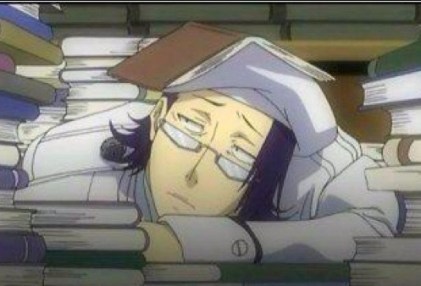
In simple terms, my research will involve studying, and creating technologies to assist in the mitigation of steadily increasing atmospheric carbon dioxide, a major global scientific challenge of the 21st century. Carbon capture is an important issue in the context of climate change as well as the looming global energy crisis; my research, will take inspiration from nature, namely the process of natural photosynthesis (the chemical reaction at the basis of life), and mimic the same behavior through electro-mechanical systems of higher efficiency, or “artificial photosynthesis.” If I were to exaggerate slightly, it would be the same as planting artificial trees that are consistently more efficient in helping recycle the carbon dioxide in the atmosphere. Having spent the last few days reading an assortment of research papers on this topic, and looking like this for the most part of it,
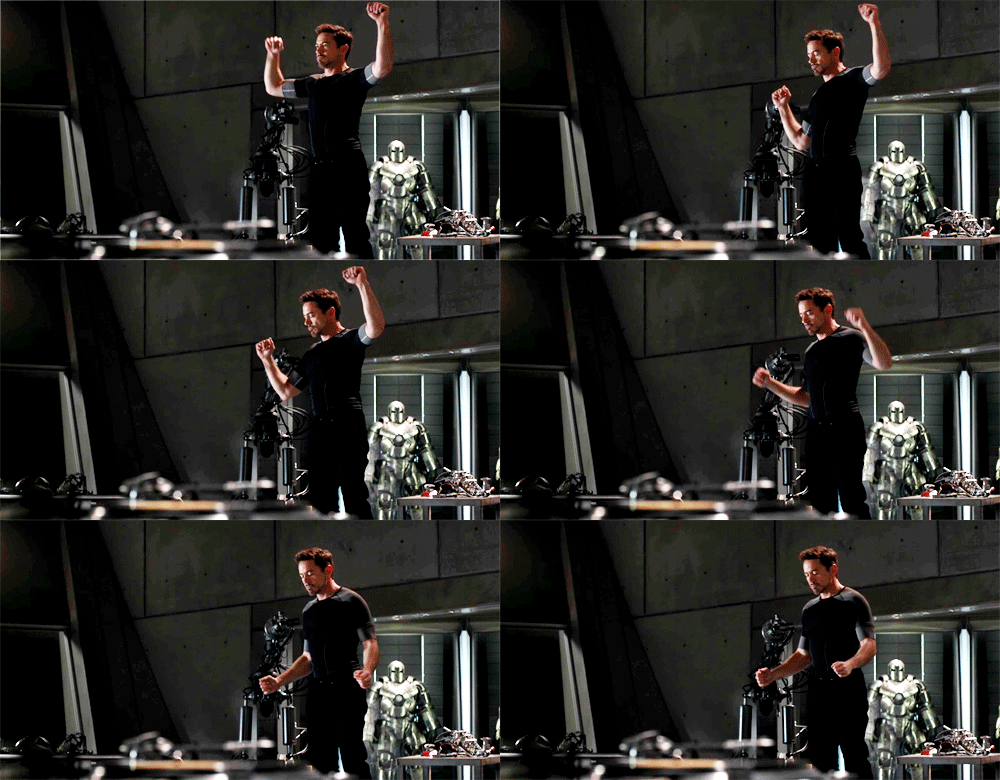
I’m hoping to put my brain to good use, and to a certain measure, come up with something awesome during my degree, so that one day I could celebrate like this,
Beyond all this research business, I still intend to keep up to date with my blog despite my busy schedule. In that vein, my next post will be a book review on Luc Ferry’s,
I’ve also decided to move along from my extensive summaries on Carl Sagan’s “Dragons of Eden.” Instead, I will provide a rich synopsis of the remainder of the book, while skipping on the gory details. This way I can encourage you, my readers, to read the book itself while not giving away the majority of its contents.
So when all is said and done, I’m fired up for what’s to come in the next few months.
The Pensive Reverie will also continually evolve as I intend to implement a few minor, but significant changes in its content organization. Once again, I thank you all for your patience. The next post should be up very soon!
Gazing out the window, I observe the tempestuous motion of clouds in the sky. The chill of a wet breeze strikes my skin as I swing along with the rhythmic motion of the trees in my neighborhood, dancing to the progressive wind. Relaxing in the comforting solitude of my humble abode, my reflections render a view across time, allowing me to travel back, and revisit the nostalgic memories of the past that led me to my current life.
A journey that began in a small corner of the world, I awakened my dreams at the sight of the luminous lamps of fire that lit up the night sky of my hometown. Contemplating on the questions that beset my curiosity, I stumbled forward, on and on, desperate to seek answers. Soaring upon the wings of my ambitions, I ventured forward into the unknown, finding strength in the arms of three beings without whom I would not be the man I am today (Mom, Dad, Sis, I love you).
Bidding farewell to our last summer, I would pave my own path in life, meeting various personalities along the way, experiences with frequent beginnings, and ends. Reinventing myself over, and over, I eventually discovered my grounds in who I wished to be in the place of another’s heart, completing a journey that brought me full circle to the little bits of everything I found in her, and appreciated in life (Thank you, Leina).
Time waits for no one…and so I wish to fall briefly into the wrenching melancholic, and bittersweet nostalgia of all that has come to be in my life so far. To the friends, and family I have met, and who have supported me along the way I give you my deep-felt thanks. Though we may be distances apart, seeking our own ends in life, our memories together will forever remain in my heart.
Now, as the tides of time push me forward, I find my resolve in the joy of our times together, and remembering those happy days we shared. Embracing the present that is built upon those memories, I find my reason to smile, thankful for all that I have been given in life. Alighting on my 26th birthday, I look toward a new, and grand horizon of adventures to follow. Thus, I’m led forward by the me of tomorrow, who holds my hand, and filled with dreams of the future, but supported all the way, by the me of yesterday, who holds all of our memories together, and follows right along…in what has been my life, or rather a passage of time…
Cherish the memories of the past, Embrace the present, and happily Anticipate the future…Time may progress inevitably, but it is our choice to make this life, a moment that transcends eternity…
Ideally, I would have had a blog post up by now. Unfortunately, I was taken unawares by a sudden bout of sickness that left me out of action for the last week.
While it has been a frustrating experience, being bedridden came with its fair share of perks, namely, a lot of reading, and brainstorming (I was physically out of it, but for some reason, my mental faculties were whizzing as usual).
Now that I have recovered to a good measure, I will have the first of a three-part series of posts discussing “Climate Change” online by next weekend. I intend to use this format such that I may be able to cover a wide spectrum of issues, concerning the topic, within the scientific, political, and socio-economic regimes. The goal is to provide for well-deserved communication, and education on a highly controversial subject that is inherently a simple, but significant, circumstance of our interaction with nature.
I will also post a book review on Luc Ferry’s, A Brief History of Thought, which I finished reading recently. Coupled with my efforts to finish my second book, I’m looking forward to a busy week of writing. I intend to move towards pre-production beginning with the necessary illustrations for the book. The goal is to have it published by the end of this summer (at the latest, fingers crossed).
Meanwhile, I shall continue to fight the good fight as I juggle my temporary term of unemployment with my academic endeavors, and my writing. It is quite difficult to keep a regular working schedule, especially when I’m spread thin over various fronts, but hey that is life! As excited as I am now to publish my second book, I can’t wait to get started on the subsequent writing projects I have in store. Similarly, there is a lot to look forward to in the near future, not to mention “evolving” another year in two weeks’ time. This post was to just inform all of you that I’m still here. Once again, I apologize for the delay!
Previously on “Adventures in Drawing,” I discussed several matters of art. I specifically placed emphasis on the three valuable lessons of learning to actively see things, the value of repetition, and drawing what one sees, not what one knows.
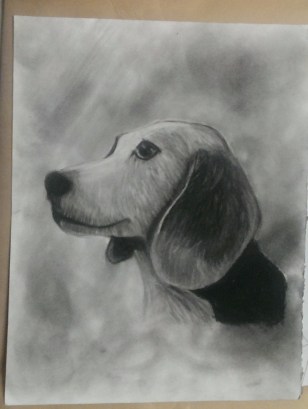
The second half of the drawing course followed the application of said rules with a series of projects. I had the wonderful opportunity to test my skills with various mediums from charcoal, graphite, and conté sticks. Along for the ride came an assortment of healthy drawing techniques I had learned earlier involving the use of guidelines, the ability to delineate depth and active perception in objects, as well as blind contour drawing etc. All in all, I thoroughly enjoyed the opportunity to test my skills with the various media (Figures 1-2).
Figure 1. Man’s best friend (using charcoal, and graphite).
Having completed the course, I can certainly say that my knowledge, and library of resources pertaining to drawing has grown exponentially. If there is a takeaway message from my experiences so far, it would be the following: simply put, anyone can be an artist. All you need is an HB pencil, a sketchbook, and a little bit of incentive. Most importantly, practice makes perfect.
In my opinion, I view drawing, and art, in general, as a personal interpretation of one’s environment, and imagination; a realm of infinite possibilities. The uniqueness factor of one’s works is dictated not through the judgment of external critics but rather one’s own individuality. Thus, you have nothing to fear in the criticism of your own doodles. We are all artists in our own measure. As Mason Cooley put it, “Art begins with imitation, and ends in innovation.”
Figure 2. Unfinished swimmer (using conté sticks)
With every passing day, I get closer to achieving the same with my artwork. Once again, I’ve learned that practice makes perfect. (On a side note, it also helps to have an encouraging partner, especially one who goes out of their way to buy you a legit Japanese manga kit but I digress.) If I could briefly summarize the steps that I have taken so far in my journey in drawing, and that I wish to share to my fellow aspiring artists, they would be:
(1) Start with doodles, and doodle frequently. Sketch whatever you wish to sketch. Freedom of imagination, and action is important in drawing.
(2) Get a few guide books on the side, or even better, just parse through the overwhelming history of artists, and their works that we can readily find information about on the WWW (world-wide-web).
(3) Trying a short, and supplementary course is highly beneficial too. Learning drawing also involves the communication of ideas, and techniques. (Check out the arts center in your city. If you don’t have one, Udemy is a wonderful online resource for awesome, and cheap courses. And if that doesn’t work, then it’s even more simple, learn from nature, and become your own artist. There’s no limit to human creativity, and imagination.)
(4) Aggregate the lessons you learn in infinitesimal steps, and integrate them toward a full learning experience.
Moving on from here, I intend to eagerly pursue my dream of becoming a mangaka in the future. For those among my readers who are avid comic fans, and are particularly interested in making their own comics, I highly suggest the constructive anatomy, and figure drawing books written by Burne Hogarth, and George Bridgman (shown below) to get you started.
But after all is said, and done, remember to relax, and just have fun with it!
Life is all about transitions. One moment, we find ourselves latched on to something, and the next instant there is something new around the corner that catches our attention. I have had to deal with my fair share of minute, but influential transitions owing to my absence over the last few weeks; ranging from decisions I have had to make on my academic career in pursuit of a PhD (which has incidentally become a wild-goose chase for funding opportunities), to my exodus in obtaining a driver’s license, and all the way to alighting upon the final stages of content editing my second book (Agent X)!
All of which brings me here today, back to my pensive reverie, during a stormy overcast in Edmonton that beckons me to take up the “keyboard” again, and get back to the blog posts I have been planning for a while. So without further ado, this is what we have to look forward to in the coming days!
Beginning with another recap of my “Adventures in Drawing” I will come full-circle as I complete my Drawing 101 course, and present a few more tricks I have learned over the past month.
Following this, we will shift gears, and in lieu with the current political “climate” (particularly with reference to the recent proceedings at the Paris Accords), I will provide a report on climate change, approaching the topic from a scientific, political, and socio-economic perspective.
I will also add another chapter to my review of Carl Sagan’s “Dragons of Eden,” as we explore the mechanisms of the human brain including the R-complex, the Limbic System, and the Neocortex.
Lastly, following up on a request from a reader, I will provide a learner’s review of Bitcoins, a crypto-currency, and modern digital payment system!
So, all in all, look forward to a good number of updates on the blog, and some healthy reading over the coming days everyone!
Making good progress on my dreams to be a mangaka in the future, I’ve spent the past two months attending a basic drawing class, and so far, I’m having a blast. This post is dedicated to my fellow amateur artists, or anyone interested in drawing; I thought it would be a worthwhile effort to provide a summary of what I have learned so far, and share my efforts with all my readers.
Art, in general, is a highly subjective field. At the first session, it was a relief to hear my instructor recite the philosophy, “Anybody can learn how to draw,” mentioning that one’s drawing ability isn’t measured by how gifted they are, but is rather a reflection of their perseverance, and efforts to hone their skills.
Though I’m only halfway through the course (four sessions out of eight in total), I’ve learned a lot. Much of this learning has involved the transcription of my observations, and perspectives of a random subject onto a paper, following three fundamental principles of drawing.
Techniques aside, drawing is the ability to closely observe your subject. It is an exercise in learning to actively see things, and deduce differences.
Figure 1 – My first work, a shoe!
Lesson 1– Learn to actively see things. Figures 1-2 describe this principle. Both figures were drawn within the same period of time, with Figure 1 drawn initially, prior to instruction, and Figure 2, after learning to remediate my ability to observe, and focus on the details of the shoe.
Figure 2 – The same shoe, after really learning to observe my subject.
Rather than have a passive approach, I was instructed to use continuous lines, which provided a sense of structure, and certainty to my artwork. Now, drawing a straight line in itself is difficult, continuous lines even more so, and it is here I found the value of repetition.
Lesson 2 – The value of repetition. It is imperative that you repeat the exercises you learn in drawing. Figure 3 presents simple exercises in “doodling,” such as drawing circles of varying sizes, and figure eights, using continuous curves (without lifting the pen). Such activities helped with hand-eye coordination, particularly with blind contour drawings.
Figure 3 – Part of aggregating your skills in drawing is to practice, repeatedly.
I spent many an hour practicing my hand/eye coordination by simply doodling around on a piece of paper. This also helped big time in learning to draw with my arm rather than my wrist which is essential when one wishes to draw continuous lines.
Lastly, I was encouraged to draw what I plainly see in my subject, and not give in to the natural urge of presupposing what I believe the subject should be from prior knowledge.
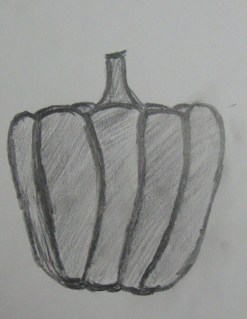
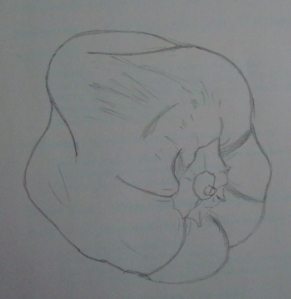
Figure 4 – The botched pepper.
Lesson 3– Draw what you see, not what you know. This makes a big difference. Figure 4 presents the infamous drawing of a pepper from memory (looks more like a pumpkin). Figure 5 presents a pepper drawn from observation.
Now, does this make a difference when it comes to drawing from imagination. I think it does, but we have to realize that our imagination is in many ways an exaggeration or extrapolation of what we observe in our reality. Learning to draw what I see in reality helped nurture my imagination.
Figure 5 – Pepper from observation. Seeing versus knowing makes a difference in drawings!
These three principles have formed the foundation of my progress in the class so far. Supplemented by lessons in individualizing one’s artwork, and finding a measure of focus, and shape consciousness (which calls for basic interaction with your subject) my drawings have come a long way (Figures 6-7).
Figure 6 – A half-finished portrait of Natalie Portman using graphite pencils, cheese cloth, and blending stumps.
Figure 7 – Another exercise in graphite. A portrait of Marcus Aurelius. I’ve still got a long way to go!
In this review, I wished to provide a generalization of the primary lessons that were essential to getting me started in drawing. Of course, there is always more to learn especially when it comes to the various techniques that can supplement your skills such as the use of guidelines, sighting angles, drawing upside down etc. But ultimately, practice makes perfect.
In my case, drawing has served as an extension to my imagination, as well as an entertaining activity in interpreting the world around me. As an art, it stresses our abilities to interact with the environment using our physical, and mental faculties, providing a medium through which one can express his/her individuality. Most of all, it is a lot of fun!
On a conclusive note, for those among my readers who live in Edmonton, I attend my drawing classes at the Edmonton City Arts Center.
The course is 8 sessions long, and is well worth the money. The City Arts Center boasts a variety of programs for adults, and children alike. If you’re interested in polishing your basics for drawing, certainly give the Drawing 1 & 2 course a try.
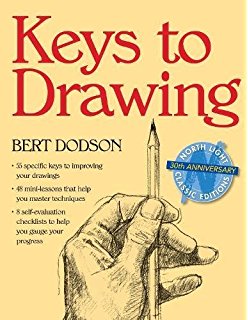
And for my readers who occupy various other corners of the world, but are aspiring artists, I would highly suggest Bert Dodson’s Keys to Drawing.
It is an excellent resource to learn the principles of drawing, and is a great complementary reference for any basic drawing course.
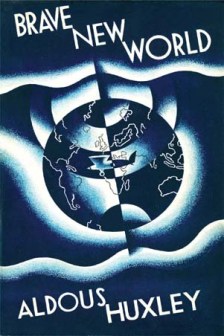
It took me about a month, but I finally finished reading Aldous Huxley’s Brave New World, completing my journey through a dystopian future set in London in the year 2540 A.D.
‘The greater a man’s talents, the greater his power to lead astray’
This quote sets the tone for Huxley’s novel, written in 1931, and published a year later in 1932. In the context of the history of the 20th century, the novel served as a unique, and menacing vision of the future during the interwar period between the end of the First World War (1914-1918), and the beginning of the Second World War (1939-1945).
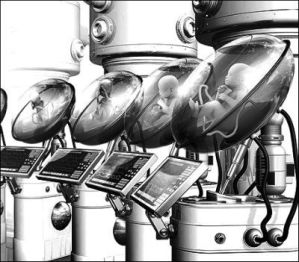
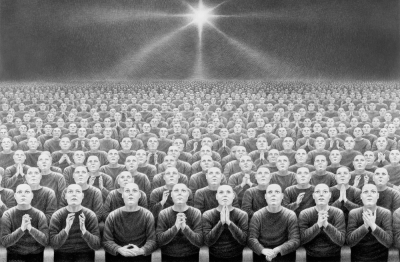
Through his skillful prose, Huxley provides a prescient view of a future where he anticipates the development of various scientific ideas such as reproductive technology, sleep-learning, psychological manipulation, and classical conditioning. Human lives are controlled by a variety of forces including genetic engineering, indoctrination, and drugs. In fact, the concept of the individual is mired, and ultimately lost in the foundation of an “ideal” society where “everyone belongs to everyone else.”
“…a bokanovskified egg will bud, will proliferate, will divide…making ninety-six human beings grow where only one grew before. Progress.”
Spontaneous human desires, and emotions are nullified by the anesthetizing public mantras, the messengers of the societal indoctrination that pervades Huxley’s world, but it doesn’t matter as “everybody’s happy nowadays.” The reader is provided entry into this bleak, but brave new world, through the daily lives, and attitudes of the major characters in the novel. Through their eyes, the reader is able to identify his/her critical opinions of a biased world where skepticism is in itself a crime, feared as an unnatural, and tainting element of the supposed balance expressed in the societal hierarchy.
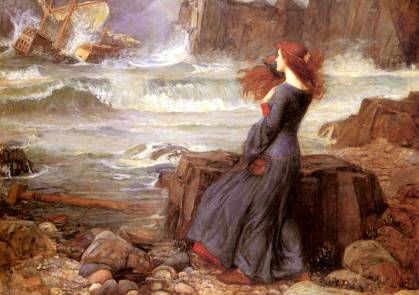
Throughout the novel, Huxley borrows heavily from the works of his predecessors. In particular, he draws inspiration from much of Shakespeare’s works, providing several quotations from The Tempest, Troilus and Cressida, Romeo and Juliet, and Macbeth to name a few. The title of the novel is in fact from Miranda’s speech in The Tempest,
“O wonder!
How many goodly creatures are there here!
How beauteous mankind is! O brave new world,
That has such people in’t.”
– William Shakespeare, The Tempest, Act V, Scene I, ll.
While Huxley himself speaks of his work’s inspiration from the utopian novels of H.G. Wells, including A Modern Utopia (1905) and Men Like Gods (1923), he disavows Wells’ hopeful vision of the future in place of the darker presentation he provides in his novel. Huxley’s novel also serves as a counterpart to the George Orwell’s 1984. The two novels differentiate themselves in the prescient views they prescribe to the future. While Orwell’s fears are borne of a world that rejects knowledge, Huxley’s fears are beset upon a world that finds knowledge redundant, or rather irrelevant.
“…most men and women will grow up to love their servitude and will never dream of revolution.”
In conclusion, I believe Huxley feared the loss of the complexities that make human culture unique in exchange for triviality. He expresses this fears through the cyclical, and largely indifferent activities that his characters engage in their daily lives. By reading the book, and finding the various allusions it provides to modern-day society, I was left exhilarated at the daunting responsibility for the future that the current generation faces amidst a rapidly changing world. The triviality that Huxley frequently alludes to in his work is evident in today’s society, dominated by social media, leaving us blind to an extent, and in much need of a reassessment of what may constitute the necessary discussions, decisions, and actions we must partake in, for the greater security of our world, and the human species as a whole.
“Again the greatest use of a human was to be useful. Not to consume, not to watch, but to do something for someone else that improved their life, even for a few minutes.” ― Dave Eggers, A Hologram for the King
While Huxley may have realized his vision of such a brave new world several years ago, his work remains today as a warning, and as a reminder of the social responsibility every individual shares in the maintenance, and regulation of the world we live in.
















 The Pensive Reverie